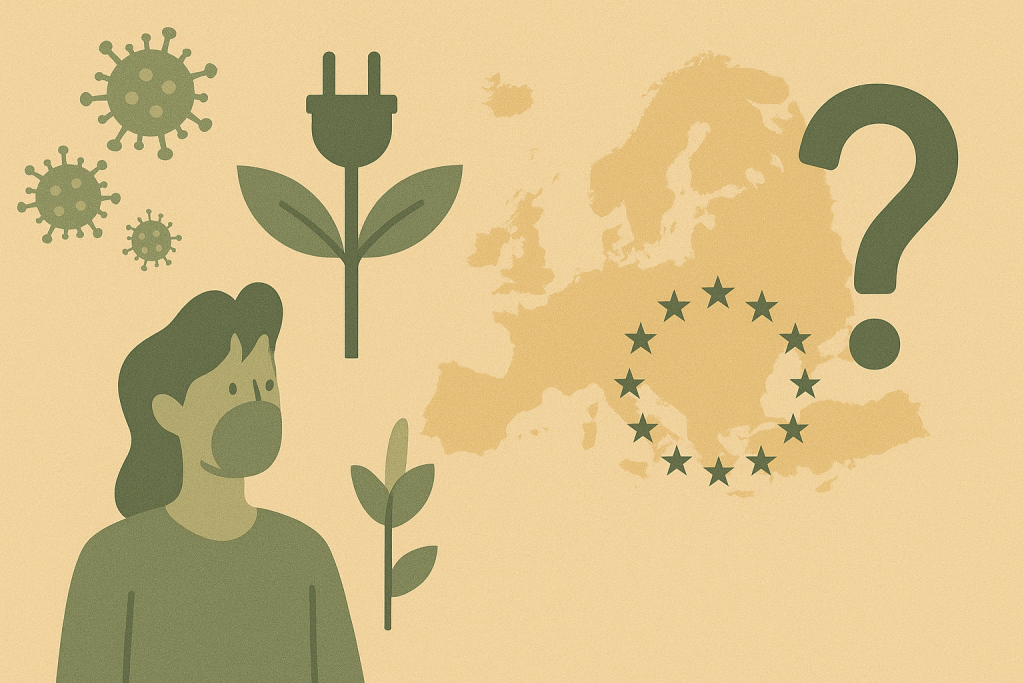
On April 10th, 17 European climate and environment ministers signed an open letter to the European Commission to use the European Green Deal as a framework to shape the EU's upcoming recovery plan. The need to scale up investments, notably in the fields of sustainable mobility, renewable energy, building renovations, research and innovation, the recovery of biodiversity and the circular economy are the pillar of European resilience. A group of 180 political decision-makers, business leaders, trade unions, campaign groups and think tanks have also urged the bloc to adopt green stimulus measures. Is there a common European strategy or national policies to shape the recovery? The EU is headed for a steep recession triggered by the outbreak, but is divided on how to finance green measures. Proposals have been put forth by several European Member States. The webinar discusses the different perspectives being actually debated.
Moderator:
Anna Creti is Full Professor at Université Paris Dauphine, Paris; Director of the Climate Economics Chair (Dauphine University) and the Economics of Gas Chair (Dauphine University, Toulouse School of Economics, IFPEN, Ecole des Mines). She is Research Fellow, Ecole Polytechnique, Paris and external Affiliate, Siebel Institute, Berkeley. Anna holds a PhD from the Toulouse School of Economics and a post-doc from the London School of Economics. She has extensively studied competition and regulation of network utilities (telecommunications, banks, gas, electricity…), as well as the link between energy, climate and environmental regulation. Anna serves as coeditor of Energy Economics and she has numerous publications in top economic journals.
Speakers:
Thomas Pellerin-Carlin now works as the Director of the Jacques Delors Energy Centre and as a Jacques Delors Institute research fellow. He works on the European Union energy policy, with a focus on innovation and climate change. Thomas previously worked in a consultancy (Europroject, Italy, 2010), the French Army, the French Administration (General Secretariat for European Affairs, 2012) in Academia for the College of Europe, (Belgium, 2013-2015) as Academic Assistant and Research Assistant of its European Energy Policy Chair.Thomas studied political science and holds a MA from the College of Europe’s Master in European Political and Administrative Studies, Bruges (2012-2013, Václav Havel Promotion) and an MA from Sciences-Po Lille (2007-2012, Promotion George Orwell).
Patrice Geoffron holds a PhD in industrial organisation and has been professor of economics at Paris-Dauphine University since 2002. Patrice used to be the international Vice-President of Paris-Dauphine and he now heads the research centre in Energy and Climate Change Economics. His research deals with the convergence between electricity and telecommunications in the transition to low-carbon energy, with a special focus on the development of smart cities, smart electricity grids, and the emergence of new organisations and new business models. He is a member of Le Cercle des économistes, one of France’s most influential think tanks and wrote a column for French newspaper Le Monde for ten years. He is a co-editor of the journal Economics and Policy of Energy and the Environment, a scientific committee member of the Revue de l’énergie and a member of the editorial board of the International Journal of Management and Network Economics.
Lara Lázaro Touza holds a PhD from the London School of Economics (LSE), an MSc in Environmental Assessment and Evaluation from the LSE and a BSc in Economics from Universidad Autónoma de Madrid. She is Senior Analyst in the Energy and Climate Change Programme at the Elcano Royal Institute in Madrid. She is also a lecturer in Economic Theory at Colegio Universitario Cardenal Cisneros (attached to Universidad Complutense de Madrid) and an Adjunct Professor of Political Economy of Climate Change at IE School of Global and Public Affairs in the Master in International Development (MID), a programme developed in partnership with the United Nations System Staff College. Prior to that she was appointed Postdoctoral Fellow at the London School of Economics. She also worked for Bloomberg. Dr. Lázaro Touza is currently working as a researcher on various publically-funded and competitive research projects, on various topics such as solar thermal electricity, the China’s Belt and Road Initiative and cooperation between Africa, the Mediterranean and Europe.
Moderator:
Anna Creti is Full Professor at Université Paris Dauphine, Paris; Director of the Climate Economics Chair (Dauphine University) and the Economics of Gas Chair (Dauphine University, Toulouse School of Economics, IFPEN, Ecole des Mines). She is Research Fellow, Ecole Polytechnique, Paris and external Affiliate, Siebel Institute, Berkeley. Anna holds a PhD from the Toulouse School of Economics and a post-doc from the London School of Economics. She has extensively studied competition and regulation of network utilities (telecommunications, banks, gas, electricity…), as well as the link between energy, climate and environmental regulation. Anna serves as coeditor of Energy Economics and she has numerous publications in top economic journals.
Speakers:
Thomas Pellerin-Carlin now works as the Director of the Jacques Delors Energy Centre and as a Jacques Delors Institute research fellow. He works on the European Union energy policy, with a focus on innovation and climate change. Thomas previously worked in a consultancy (Europroject, Italy, 2010), the French Army, the French Administration (General Secretariat for European Affairs, 2012) in Academia for the College of Europe, (Belgium, 2013-2015) as Academic Assistant and Research Assistant of its European Energy Policy Chair.Thomas studied political science and holds a MA from the College of Europe’s Master in European Political and Administrative Studies, Bruges (2012-2013, Václav Havel Promotion) and an MA from Sciences-Po Lille (2007-2012, Promotion George Orwell).
Patrice Geoffron holds a PhD in industrial organisation and has been professor of economics at Paris-Dauphine University since 2002. Patrice used to be the international Vice-President of Paris-Dauphine and he now heads the research centre in Energy and Climate Change Economics. His research deals with the convergence between electricity and telecommunications in the transition to low-carbon energy, with a special focus on the development of smart cities, smart electricity grids, and the emergence of new organisations and new business models. He is a member of Le Cercle des économistes, one of France’s most influential think tanks and wrote a column for French newspaper Le Monde for ten years. He is a co-editor of the journal Economics and Policy of Energy and the Environment, a scientific committee member of the Revue de l’énergie and a member of the editorial board of the International Journal of Management and Network Economics.
Lara Lázaro Touza holds a PhD from the London School of Economics (LSE), an MSc in Environmental Assessment and Evaluation from the LSE and a BSc in Economics from Universidad Autónoma de Madrid. She is Senior Analyst in the Energy and Climate Change Programme at the Elcano Royal Institute in Madrid. She is also a lecturer in Economic Theory at Colegio Universitario Cardenal Cisneros (attached to Universidad Complutense de Madrid) and an Adjunct Professor of Political Economy of Climate Change at IE School of Global and Public Affairs in the Master in International Development (MID), a programme developed in partnership with the United Nations System Staff College. Prior to that she was appointed Postdoctoral Fellow at the London School of Economics. She also worked for Bloomberg. Dr. Lázaro Touza is currently working as a researcher on various publically-funded and competitive research projects, on various topics such as solar thermal electricity, the China’s Belt and Road Initiative and cooperation between Africa, the Mediterranean and Europe.
SUR LE MÊME THÈME
ON THE SAME THEME
PUBLICATIONS
The EU Green Deal in a volatile world
An ambitious plan without adequate financing?
The need for a socially-just European Green Deal
MÉDIAS
MEDIAS
L’Europe ira-t-elle au bout de ses ambitions environnementales ?
Les objectifs climatiques européens difficilement atteignables d’ici 2030
La bataille des subventions menace l’unité de l’Europe
Biodiversité, le moment européen
Environnement : « Punir ne marche pas », selon le vice-président de la Commission européenne
Normes environnementales : « On n’a pas le luxe de pauses », juge le vice-président de la Commission européenne
Une « pause réglementaire » sur l’écologie ? La Commission européenne répond à Emmanuel Macron
Climat : une pause réglementaire comme le veut Emmanuel Macron ? « On n’a pas le luxe d’en faire », répond Bruxelles
Green Deal: EU’s Timmermans rules out ‘break’ in the green transition
Commission Executive Vice President Frans Timmermans in Paris for Conférence Jacques Delors 2023 — la Transition Ecologique
Pacte vert européen: les appels à une “pause” créent des remous à Bruxelles
L’Europe de la santé : des avancées en façade, des réserves dans les faits
L’Union européenne, leader climatique aux pieds d’argile
UE : les eurodéputés valident plusieurs textes environnementaux déterminants
EU Commission pushes for joint purchasing of raw materials
Industrie propre : le nouveau plan européen a du mal à convaincre
Cette directive de l’Union européenne ne “prévoit” pas d’empêcher les propriétaires de biens énergivores d’habiter leur logement
Pénurie de médicaments : les premières réponses de l’Union européenne
TECHNOLOGIES VERTES : LES CRISES EN SÉRIE DYNAMITENT LES RÈGLES DU JEU DU LIBRE-ÉCHANGE SOUS COUVERT D’ACTION CLIMATIQUE
L’Union européenne tarde à déployer tout son plan de relance
Covid-19 en Chine : l’Europe saura-t-elle tirer les leçons de trois ans de crise ?
Chine : priorité à l’économie
L’Europe dope son arsenal anti-crise sanitaire
Chine : Xi Jinping tout puissant
« Poutine utilise le gaz comme une arme de chantage énergétique pour diviser les Européens »
Europe : le Pacte Vert sous pression russe
Health systems need to be better than pre-pandemic levels, say experts
«La pandémie a agi comme un électrochoc montrant les failles du dispositif européen de santé actuel»
« Fit for 55 » : Après l’accord au Conseil, les eurodéputés alertent sur le risque de résurgence des Gilets jaunes
Pourquoi le futur marché européen du carbone menace la paix sociale… et le climat
Social Climate Fudge
Fit for 55 : des accords à l’arrachée… au prix d’une ambition revue à la baisse
Green deal: la victoire à la Pyrrhus des partisans des carburants alternatifs
Allemagne : un retour au charbon, pour combien de temps ?
Climat : le fonctionnement du marché carbone de l’UE en 8 questions
Plus de vente de voiture thermique neuve dès 2035 dans l’UE
Officiel : l’Europe acte la fin des voitures thermiques pour 2035
Climat : Un rendez-vous historique manqué au Parlement européen sur le « Fit for 55 » ?
Le Parlement européen vote la fin des ventes de véhicules thermiques neufs en 2035
La fin de la voiture thermique ne concernera pas les Ferrari
Pacte vert européen: Pascal Canfin retourne à la case départ
La fin des ventes de voitures thermiques neuves dans l’UE promise dans 13 ans
Climat : voici sur quoi porte le vote historique du Parlement européen
Vote du Parlement européen sur le paquet climat Fitfor55
Ralentissement de la mondialisation
War, hunger, Covid-19 cast gloomy shadow over Europe
Guerra, fame e Covid proiettano ombre lunghe sull’Europa
Crise de l’hôpital : la France n’est pas un cas isolé en Europe
Crise alimentaire : “C’est une tempête qui va durer”, estime Pascal Lamy, président de l’Institut Jacques Delors
Covid, guerre, inflation, crise alimentaire : quels sont les dangers qui planent sur l’Europe
“L’Europe est un nain” : entre inflation, guerre et sécurité alimentaire, ces crises qui planent au-dessus de l’Europe
Bientôt la stagflation en zone euro?
Taxe carbone aux frontières de l’Union européenne : le début d’un long chemin
Interview Pascal Lamy
Les eurodéputés approuvent une nouvelle commission spéciale sur la Covid-19
“Il faut concevoir un Plan Marshall pour notre souveraineté énergétique”
La guerre russe en Ukraine menace aussi la transition énergétique de l’Europe
Révision de l’ETS, l’Institut Jacques Delors et E3G plaident pour une élimination totale des quotas gratuits d’ici 2030
Deutschlands Impfpflicht-Debatte – Was machen die EU-Länder?
Transition énergétique : qu’est-ce que le Fonds social pour le climat ?
L’Europe peut-elle être le fer de lance de l’environnement?
Climat : comment Berlin compte se sevrer définitivement des énergies fossiles
Faute d’exploiter ses mines, l’Europe doit miser sur le recyclage
Omicron puts Macron’s grand EU presidency plan at risk
UE: la polémique sur les non-vaccinés risque de brouiller le premier temps fort de la présidence française
Emploi, pouvoir d’achat, investissements… Les vrais coûts de la transition énergétique
Le casse-tête du financement du nouveau nucléaire
Un an plus tard, rendons justice au vaccin: il n’est pas qu’une polémique
Europe Braces for Winter, with Aitor Hernández-Morales & Thomas Pellerin-Carlin
Europe’s social climate fund too small to make a difference, critics say
En Europe, l’opération survie de l’industrie lourde
Covid : quel impact sur le fonctionnement de nos démocraties ?
Le point sur la Covid au Canada et en Europe
«La Covid-19, révélateur des fragilités des démocraties européennes». La tribune de Thierry Chopin (Institut Jacques Delors)
« Nous sommes entrés dans une situation de prix élevé des énergies fossiles »
Le marché carbone européen à l’épreuve de la crise de l’énergie
Vaccination obligatoire au Canada, Etats-Unis et en Europe
FT Europe Express: Social climate gap
Bruxelles cherche des solutions pour contrer le « choc » des prix de l’énergie
La Commission européenne présente une « boîte à outils » pour lutter contre la hausse des prix énergétiques
Frankreich setzt weiter auf Kernenergie
Union européenne: faut-il une réforme de l’énergie?
Macron’s €30B end-of-term bet to make France great again
Compétitivité, pilotage, “mirage technologique”… les réactions au plan “France 2030”
“France 2030” : Pour Macron, la technologie va sauver le climat, mais cela sera-t-il suffisant ?
Thomas Pellerin-Carlin: “La vraie solution, c’est de nous débarrasser du gaz”
L’Institut Jacques Delors critique le projet de Fonds social pour le climat et l’extension du système ETS
Le grand débat – Le nucléaire, une énergie verte ?
Europe must seize its chance to lead the world in cleantech
Entre politique industrielle et Pacte vert, l’Europe sur un fil
Appel : Un pacte de résilience et de solidarité pour remplacer le pacte de stabilité et de croissance
Comment l’Allemagne est parvenue à réduire ses émissions de CO₂ deux fois plus vite que la moyenne européenne
Opinion | Développement durable : faisons 2030 dès 2022
LE GAZ C’EST DE L’OR
Plan France 2030 : la recherche pour le climat prioritaire, soulignent des «think tanks»
Should the EU create a European carbon market for road transport and buildings?
Union européenne : quel est l’agenda de sortie de crise pour Ursula von der Leyen?
Pellerin-Carlin : Bruxelles se prépare à reconnaître le nucléaire comme une énergie « verte »
Researcher: Brussels is paving the way for nuclear power’s green revival
Climate tops list of global threats in EU ‘strategic foresight’ report
‘Back to work’ for Europe: Afghanistan, Covid-19 and ‘auf Wiedersehen’ to Angela Merkel
Vaccination : des inégalités qui fracturent le monde
Along With COVID-19, EU Faces a More Fundamental Battle
Où en est la taxonomie verte européenne ?
EU countries are throwing away expired vaccine doses
EU-Klimapaket: Frankreich warnt vor Gelbwestenprotesten
PRIPRAVLJENI NA 55?
Le marché du carbone pour le bâtiment : « une politique à haut risque et à faible rendement », pour l’institut Jacques-Delors
Pacte vert européen : comment décarboner l’économie ?
Pacte vert européen: à Bruxelles, un mélange d’amertume et d’optimisme
« Fit For 55 » : la France sceptique sur l’extension du marché carbone aux bâtiments et aux transports
Pacte vert européen : pourquoi le projet d’extension du marché carbone fait grincer des dents
Paquet climat européen : « On entre dans le dur du pacte vert »
Paquet européen sur le climat : quel impact sur les citoyens ?
L’UE veut mettre sur les rails la première taxe carbone aux frontières au monde
«Green deal» européen : des annonces ambitieuses et périlleuses