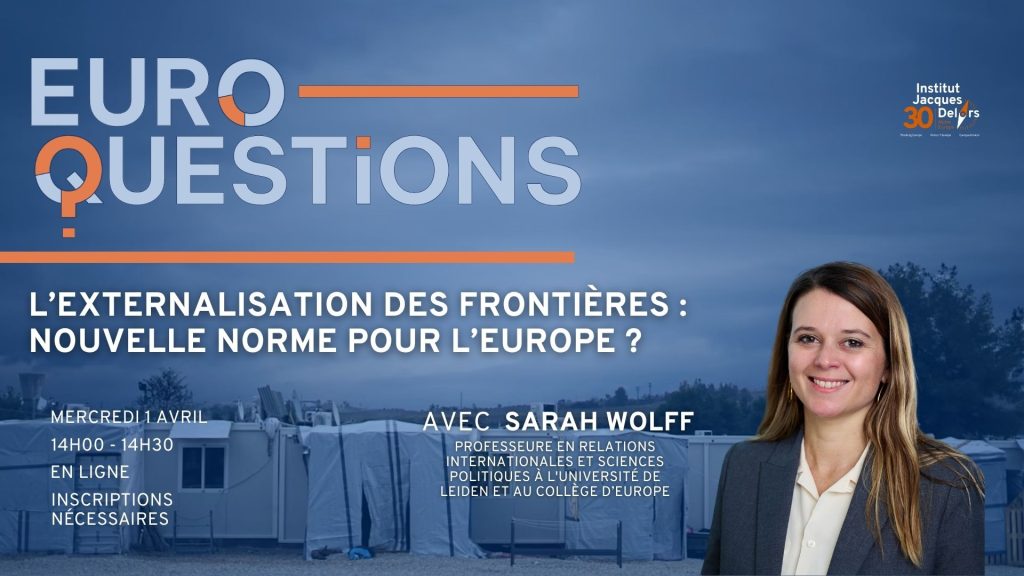
EuroQuestions | 10 Years After the EU–Turkey Migration Agreement: Has Border Externalisation Become the Norm in European Migration Governance? with Sarah Wolff
Online
Speakers
 Sarah Wolff Professor in International Studies and Global Politics at Leiden University, Visiting Professor at the College of Europe
EuroQuestions : Season 2026, Episode 6
*This EuroQuestions will be in French
Date / Place: 1 April 2026, 2:00–2:30 p.m. (CET), online (registration required)
Title:
10 Years After the EU–Turkey Migration Agreement: Has Border Externalisation Become the Norm in European Migration Governance?
Background:
Ten years after the EU–Turkey statement of March 2016, the EU appears to have gradually institutionalized outsourcing as a central pillar of its migration governance—a key instrument for managing the readmission of irregular migrants to third countries.
Concluded in the context of the 2015–2016 “migration crisis,” the EU–Turkey statement aimed to limit irregular arrivals by returning migrants or refugees who had crossed the Greek border illegally to Turkey, accompanied by European financial support for the management of migrant populations in Turkey.
A decade later, the entry into force of the Asylum and Migration Pact, scheduled for June 2026, marks a new stage in the evolution of the European migration framework. This EuroQuestions session will focus on three key dimensions:
- The evolution of outsourcing in European migration governance
The EU has strengthened partnerships with Tunisia, Egypt, and Mauritania, but these often informal agreements raise significant questions regarding democratic and legal governance. - The normative framework and the concept of a “Fortress Europe”
This discussion will examine the coherence between the Union’s declared democratic and normative commitments and the concrete implementation of these agreements, while analyzing their impact on the EU’s neighborhood. - The long-term legal and operational viability of the Migration Pact
Return and readmission procedures may fall outside parliamentary and judicial oversight, raising fundamental questions about responsibility for fundamental rights.
Questions to answer:
- Is the EU–Turkey agreement a precursor to outsourcing, and does it represent a lasting turning point for European migration governance?
- How does the Migration and Asylum Pact formalize outsourcing, and to what extent is it legally regulated and feasible in the long term?
- Within which values framework are EU agreements with third countries established, and what is their impact on those countries?
Speaker(s):
Sarah Wolff is a Professor of International Relations and Political Science at Leiden University and the College of Europe. Her research focuses on EU migration and asylum policies, as well as the EU’s relations with the Middle East, North Africa, and the Islamic world. Her latest article, published by Global Europe and titled “European Union Migration Policy in Times of Geopolitical Upheaval”, is directly relevant to this EuroQuestions session. Her latest project focuses on a feasibility study on a European maritime rescue system. She is currently working on the sense of belonging of European Muslims to the European Union.
What are EuroQuestions?
EuroQuestions are 30-minute online discussions held two to three times a month, bringing together a moderator (either Christine Verger or William Malaterre) and a guest speaker to discuss a pressing European issue. The guest speaker typically delivers a 15–20-minute presentation, followed by a 10-15-minute discussion with the moderator.
Online
Speakers
- Sarah Wolff Professor in International Studies and Global Politics at Leiden University, Visiting Professor at the College of Europe