
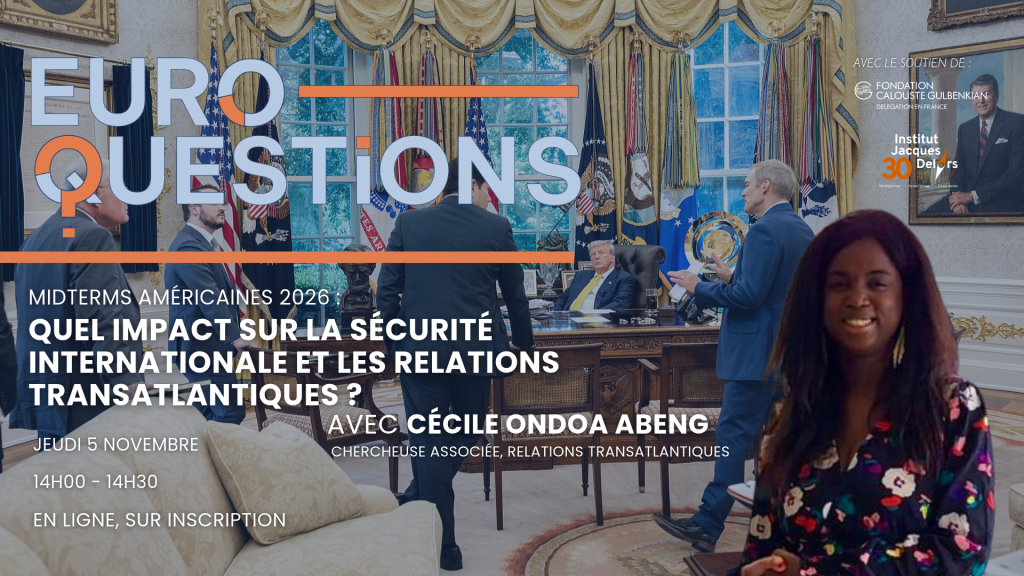
EuroQuestions | The 2026 US Midterm elections: What impact will they have on international security and transatlantic relations? with Cécile Ondoa Abeng
Speakers


EuroQuestions : Season 2026, Episode 19
*This EuroQuestions will be in French.
Date / Place: 5 November 2026, 2:00–2:30 p.m. (CET), online (registration required)
Title:
The 2026 US Midterm elections: What impact will they have on international security and transatlantic relations?
Background:
The results of the 3 November elections in the United States are being closely scrutinised around the world. Halfway through Donald Trump’s second term, they serve as an indicator of how American voters assess his performance since his return to the White House. More so than in other countries, international issues can exert a significant influence on political debates in the United States. In this regard, Trump went into these elections in a difficult position, as he faced a disillusioned base due to the increasing number of military interventions which he had promised to end. This was all the more so as these interventions had not produced the expected results (Iran), nor had the mediation initiatives undertaken by the Trump administration (Ukraine). All this took place against a backdrop of a sluggish economy, characterised in particular by persistent inflation.
The election results could therefore alter the balance of power in Congress and redefine the Trump Administration’s room for manoeuvre, including in the area of foreign policy.
This edition of EuroQuestions will draw initial lessons from the mid-term elections and analyse their implications for Trump’s ability to pursue his current foreign policy priorities. Caught between his stated ambition to end conflicts and his reliance on shows of force, the US President maintains an ambivalent stance on the role of the United States on the international stage. Could a potential change in the majority in one of the houses of Congress limit his diplomatic and military initiatives, or, on the contrary, reinforce certain aspects of his foreign policy?
Finally, what consequences might these elections have for Europe? At a time when the European Union is facing an uncertain geopolitical and geo-economic environment – characterised by trade disputes with the United States, the war in Ukraine and tensions in the Middle East – this edition of EuroQuestions will analyse the implications of the mid-term election results for transatlantic relations and European security.
Questions to answer:
- What political lessons can be drawn from the mid-term election results? To what extent might a change in the composition of Congress constrain or reorient the Trump administration’s foreign policy choices?
- Between a stated desire for disengagement, an ambition to mediate and the use of force, how might one characterise Washington’s current role in conflict resolution and the maintenance of international security?
- What are the implications for transatlantic relations and European security?
Speaker(s):
Cécile Ondoa Abeng served for more than ten years as a diplomat at the Ministry for Europe and Foreign Affairs, notably at the Centre for Analysis, Forecasting and Strategy (CAPS) and in Quebec. Between 2020 and 2022, she served as an adviser to President Emmanuel Macron, responsible for the Americas, international foresight and the Generation Equality Forum, having previously been a diplomatic adviser to the Paris Peace Forum. A specialist in the United States, transatlantic relations and multilateral and influence issues, she is currently a research fellow at the Jacques Delors Institute.
What are EuroQuestions?
EuroQuestions are 30-minute online discussions held two to three times a month, bringing together a moderator (either Christine Verger or William Malaterre) and a guest speaker to discuss a pressing European issue. The guest speaker typically delivers a 15–20-minute presentation, followed by a 10-15-minute discussion with the moderator.