Trade Rounds – After the Supreme Court’s decision: trade in Trump’s second year
Authors


 Chad Bown Senior Fellow, au Peterson Institute for International Economics et ancien économiste en chef du Département d’État des États-Unis
 Thierry Mayer Professor of Economics, Sciences-Po Paris
After the Supreme Court: trade in Trump’s second year
A conversation with Chad Bown and Thierry Mayer, moderated by Elvire Fabry. PSIA–Jacques Delors Institute trade series, 10 March 2026.
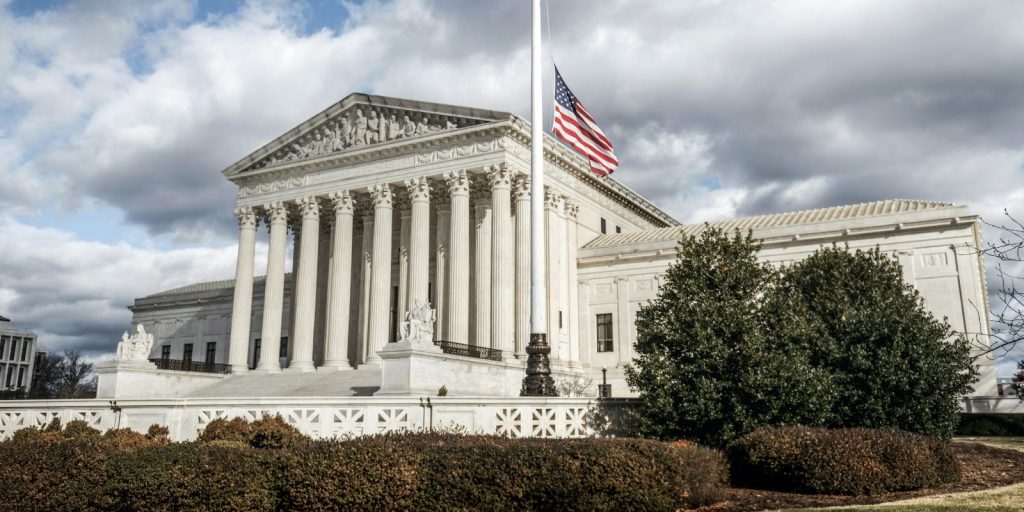
The third instalment of the PSIA–Jacques Delors Institute trade series brought Chad Bown (senior fellow at the Peterson Institute for International Economics, and formerly chief economist at the US State Department under President Biden) into conversation with Thierry Mayer (Sciences Po) and Elvire Fabry (JDI). The timing was fortunate. Days earlier, the US Supreme Court had struck down the bulk of the IEEPA tariffs that had defined Donald Trump’s first year back in office. The discussion took place against that backdrop: what we have learned from a year of trade turbulence, and what comes next now that the legal foundation has shifted under the administration’s feet.
A year that broke MFN
Bown opened with the data. After twelve months of Trump 2.0, US average tariffs sit at levels last seen in the 1930s. The defining feature, beyond the levels themselves, has been the abandonment of most-favoured-nation treatment. Europe, Japan, Korea and Taiwan landed at roughly 15%. South Asian economies (Vietnam, Indonesia, Malaysia) at 18 to 20%. China, after a peak escalation of 145 percentage points, settled around 50%.
But the headline numbers obscure what actually happened to trade flows. US imports from China fell by close to 30%. Yet total US imports grew by roughly 5%, with imports from the rest of the world up by something closer to 10%. Three stories explain that pattern. First, some supply chains shifted: Apple’s iPhone assembly in India is the clearest case, with smartphones from India carved out even of the country-specific tariffs Trump imposed in August over Russian oil. Second, the AI build-out drove a surge in imports of semiconductors, racks and data-centre equipment from Taiwan and Mexico, much of it exempted. Third, some supply chains did not move at all, including the one that ultimately mattered most. China processes roughly 90% of the world’s rare earths and permanent magnets, and Beijing’s decision to restrict exports was the moment that ultimately forced Washington to pause the escalation.
Who actually paid
Mayer walked through the empirical answer that has emerged from the first wave of studies on Trump 2. Looking at millions of transactions, export prices behaved very much as they had under Trump 1: foreign exporters absorbed almost none of the cost. US consumers ate 96 to 97% of the tariff. The administration’s central claim, that exporting countries would carry the burden, did not survive contact with the data.
In aggregate terms, the GDP hit is most severe for the United States itself (minus two to three percentage points in most estimates), with serious effects on China, Canada and Mexico. The EU comes off lightly in headline terms (minus 0.2 to 0.3%), partly because France barely exports to the US outside aerospace, which was exempted. Sectoral exposure is much more uneven. Cars are the obvious case: Canada and Mexico face output falls of around 20%, while Italy is harder hit in Europe than France because of the Jeep plant exporting heavily to the US. One striking finding from recent work: firms have begun to redirect sourcing away from countries where Trump’s announced rates oscillate week to week, and towards countries where the rate is certain, even if higher. Volatility itself functions as a tariff.
The post-SCOTUS landscape
The Supreme Court ruling tore up most of the legal architecture of the first Trump year. The administration’s immediate response was to reach for Section 122, which permits across-the-board tariffs of up to 15% for six months on balance-of-payments grounds. Two features matter. Section 122 expires at the end of July. And it does not allow country-by-country discrimination, which is exactly what the administration had built. To rebuild that structure, the White House would need to use Section 301, Section 232 or other authorities requiring formal investigations, evidence and consultation. A few weeks in, those investigations are not yet visible. The Turnberry agreement, signed in July on the basis of tariffs that have since been ruled illegal, sits in a strange legal limbo.
Mayer’s reading of Turnberry was sharp. The European Commission has, for decades, known how to fight a tariff war. Pascal Lamy’s targeting of Florida oranges remains the textbook case, and through January Brussels was signalling that it would use every tool available. By March, that posture had collapsed into an unequal deal, apparently in exchange for assurances on Ukraine, security and the digital rulebook that were never credible in the first place. The SCOTUS ruling reopens that choice. The lesson he drew from the US–China escalation is one Brussels should internalise: do not escalate into a confrontation where the other side holds the bigger weapon. Assess the balance of leverage through both imports and exports before reaching for instruments, and maintain unity, because France’s isolation in the run-up to Turnberry made the unequal outcome possible.
How to win a trade war
Bown previewed the argument of his forthcoming book, co-written with Soumaya Keynes. The honest economist’s answer to « how do you win a trade war » used to be « you don’t play ». That answer is no longer on offer; the wars are being imposed on us. The book’s response is to take seriously a set of policy instruments (tariffs, subsidies, export controls, stockpiles) that economists trained over the past three decades had largely set aside. One thread is particularly relevant for the EU: the 1970s oil shock prompted the creation of strategic petroleum reserves and the International Energy Agency. The contemporary equivalent for rare earths, critical minerals and permanent magnets is an open question, and one well worth Europe’s attention.
Coalitions, the WTO and the long horizon
A recurring theme of the Q&A was coalitions. Bown reflected, from his former vantage point at the US State Department, on how difficult coalition-building was with the United States inside the tent. It may, paradoxically, be easier to assemble a meaningful coalition without it. Mayer was direct on the WTO: large emerging economies (India, Brazil, Indonesia) ought to be defending the multilateral system far more energetically than they are. They benefited most from it, and they are best placed to suffer in its absence.
Asked whether trade might return to « normal » under a different US administration, Mayer was unsentimental. The new instruments, once governments have them, will not be relinquished quickly. Building the WTO took decades, in an era when the constituency for openness was wider and corporate concentration weaker. He also pushed back, gently but firmly, on the strand of European thinking (associated with parts of the Letta report) that would soften competition policy to allow continental champions to scale. Competition policy also keeps firms from accumulating the rents that protectionism distributes, and pulling those rents back later is hard.
On the dollar, an audience question elicited a useful observation. Standard models predicted that unilateral tariffs would push the dollar up. Instead it has fallen, because uncertainty has pushed capital out of the United States. That is broadly consistent with the macro objective some in the administration had spelled out before taking office, but it sits awkwardly with the inflation problem the same policies are generating.
Closing the session, Fabry offered three takeaways the institute will continue to work on. First, this is not a parenthesis but a new trade world. Second, clarity on US objectives is not coming, but clarity on European resilience and unity can be built now. Third, the project of stabilising the global order will run through coalitions of partners well beyond the transatlantic frame, as much as through the WTO itself.
Authors
- Chad Bown Senior Fellow, au Peterson Institute for International Economics et ancien économiste en chef du Département d’État des États-Unis
- Thierry Mayer Professor of Economics, Sciences-Po Paris