Beijing: The Art of Turning Culture into Power
Authors


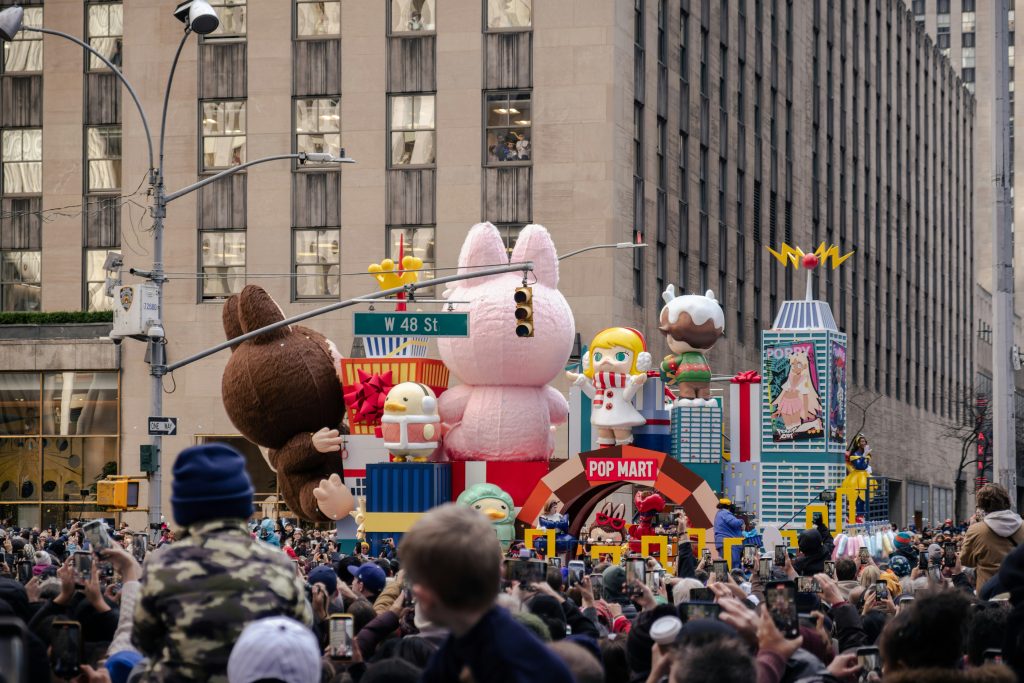
At the opening of the 2026 FIFA World Cup in North America, curious Chinese soft toys with pointed ears and unsettling smiles caused a sensation on the pitch.
This phenomenon, which at first glance may seem trivial, reveals a major shift. The “Labubus”, produced by the Hong Kong-based brand Pop Mart, have become one of the most sought-after items on the planet in the space of just a few months. Whilst China’s political image remains widely contested, its cultural products are winning over an ever-wider audience.
Indeed, despite its economic boom, the Covid-19 pandemic was accompanied by a rise in anti-Chinese sentiment in the West and across much of Asia; the crackdown in Hong Kong, as well as international scrutiny of China’s policies in Xinjiang, have entrenched the perception of China as an authoritarian and threatening power.
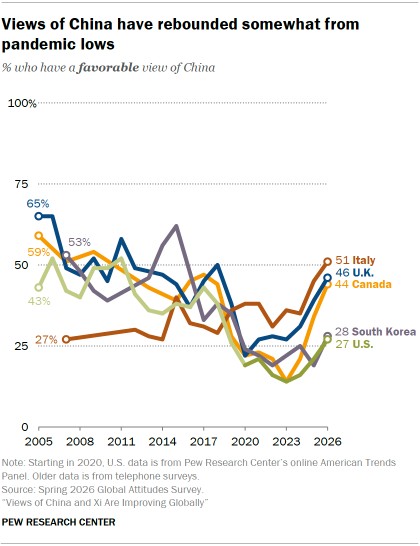
Donald Trump’s return to the White House coincides with Beijing’s desire to improve its image by presenting itself as an alternative to US hegemony. Against this backdrop, culture has become a strategic priority: both as a means of countering China’s negative image and as a tool of influence intended to strengthen its global position by attracting tourists, investors and talent. This strategy already appears to be yielding some results, as shown by the changing global perception of China illustrated in the graph below.
The Confucius Institutes: the limits of an overly visible strategy
When one thinks of China’s cultural strategy, the Confucius Institutes spring to mind first. The Chinese equivalent of the French Institutes, these centres for language teaching and the promotion of Chinese culture abroad were launched in 2006 by the ‘Haban’ association (which reports directly to the Chinese government). By 2016, the initiative had expanded to more than 170 institutes across Europe.
However, as early as the 2010s, criticism of the institutes began to mount, depicting them as organs of official propaganda, including Valérie Niquet1 and Brice Pedroletti.
In 2021, a report by IRSEM documented instances of interference by Confucius Institutes in the academic freedom of European universities and reported systematic self-censorship on sensitive topics (Tibet, Taiwan, Tiananmen). First, Sweden was the first country to close all its institutes, while several other European countries subsequently ended university partnerships. By 2023, they were operating within a more restrictive framework, and their number had fallen to 111 institutes across the EU. The Confucius Institutes thus represent a relative failure for Chinese cultural policy; this ‘overly visible’ strategy will therefore be replaced by less visible channels of influence”.
China’s cultural ambitions have been gaining momentum in recent years
The five-year plans, inspired by the Soviet model, set out the objectives established by the Party for a five-year period. They set strategic priorities and guide policies and investment across the state apparatus. Since the 1990s, these plans have served as an instrument of political continuity in all areas deemed strategic by the government. Culture, as an instrument of soft power, is one such area.
An analysis of the five-year plans allows us to trace the evolution of China’s cultural ambitions. With the notable exception of the 2008 Beijing Olympic Games, the Hu Jintao era (2002–2012) prioritised economic development and infrastructure over the external projection of Chinese culture. This shift has gradually accelerated under Xi Jinping.
The 13th Five-Year Plan (2016–2020) is, first and foremost, a plan for a consolidation of a common national cultural identity. The main objective is to consolidate a homogeneous national cultural identity, with a view to developing and protecting ‘excellent traditional Chinese culture’.
_____________________________________________________________________________________________________________
[FOCUS 1]
What is ‘outstanding traditional Chinese culture’? (‘传承弘扬中华优秀传统文化’)
A concept introduced during Deng Xiaoping’s administration (1980–1992) and systematised under Xi Jinping as a central tool of the Chinese Communist Party’s ideological apparatus.
The deliberately vague definition of this term allows it to encompass a wide range of cultural projects, both ancient and contemporary, such as the classical Taoist and Buddhist textual corpora, the legendary history of the three pre-imperial dynasties—Xia, Shang and Zhou—traditional medicine, and ceramic techniques from the Ming and Qing periods.
This concept of ‘traditional culture’ serves a dual purpose: in domestic politics, it helps to legitimise the regime by selecting elements that emphasise China’s historical continuity; in foreign policy, it establishes a civilisational narrative that legitimises China’s status and international ambitions. The incorporation of this concept into its institutional ideological framework therefore demonstrates the Chinese Communist Party’s determination to plan its cultural governance.
_____________________________________________________________________________________________________________
The 14th Five-Year Plan (2020–2025) builds on this ideological work and encourages the digitisation of cultural products intended for export. Cultural policy is no longer focused solely on domestic cohesion; it increasingly seeks to reach international audiences. This is the ‘Go Global’ (走出去, zou chuqu) strategy, which calls on all levels of the administrative hierarchy to authorise, promote and support the promotion of China’s culture and history abroad.
Finally, the recent 15th Five-Year Plan (2026–2030) explicitly defines culture as a geopolitical tool. It unequivocally affirms the need to “better shape public opinion” through large-scale projects. The 15th Five-Year Plan thus continues the strategy summarised by Xi Jinping that we must “tell China’s stories better” (讲好中国故事) in order to present a China that is “credible, attractive and respectable”. Culture is therefore not just one sector amongst many; it is an instrument of internal cohesion and external projection.
Beyond Soft Power
China’s 15th Five-Year Plan goes beyond the academic definition of ‘soft power’ as theorised by the American geopolitical scientist Joseph Nye. ‘Soft power’ is traditionally based on the idea of attracting others through civil society: a country exerts cultural influence because its way of life is desirable.
China seeks to build its appeal through two additional channels: the interest in its millennia-old cultural heritage, which remains largely misunderstood internationally (see Box 1), and its ability to redefine norms and challenge Western dominance. This is known as ‘discursive power’ (话语权).
_____________________________________________________________________________________________________________
[FOCUS 2]
Discursive power (the power of discourse) is a concept theorised by Michel Foucault at the Collège de France in *The Order of Discourse* (1970). From this perspective, control over discourse is itself a form of power: it determines which narratives gain legitimacy and which are marginalised.
This concept has been reappropriated by the Chinese Communist Party to address the discrepancy between its capacity for influence on the international stage and its economic and military might. In the Mandarin formulation, 权 (quán), ‘power’, forms the semantic core: it refers not only to having a voice, but more importantly to exercising influence over the terms of the debate itself. Where attraction alone proves insufficient, Beijing also seeks to shape the frameworks through which China is perceived and to marginalise narratives it regards as unfavourable.
_____________________________________________________________________________________________________________
Technology as a vehicle for China’s cultural ambitions
The 15th Five-Year Plan promotes the digital development of culture as a twofold opportunity. On the one hand, the use of digital platforms accelerates the international dissemination of Chinese culture, enabling it to adapt rapidly to diverse audiences.
On the other hand, the visible deployment of advanced technologies helps China reshape its international image by presenting itself not only as a millennia-old civilisation, but also as a country at the forefront of technological innovation, indispensable to the world of tomorrow.
Light shows featuring swarms of giant drones, futuristic skylines illuminated by vast LED displays such as Chongqing or Shenzhen and hotel delivery robots, widely shared on social media, are strongly encouraged in this regard and contribute to this image of a country looking to the future.
Following the failure of more traditional attempts at cultural influence via the Confucius Institutes, the Chinese government has realised that the internet is the most accessible means of reaching diverse audiences. Although China is active in many cultural sectors, such as promoting its cuisine, fashion and even collective toys, in the following articles we will focus on two sectors receiving substantial government support: audiovisual media and video games.
Footnotes