Europe and the three outcasts of Shenzhen
Authors

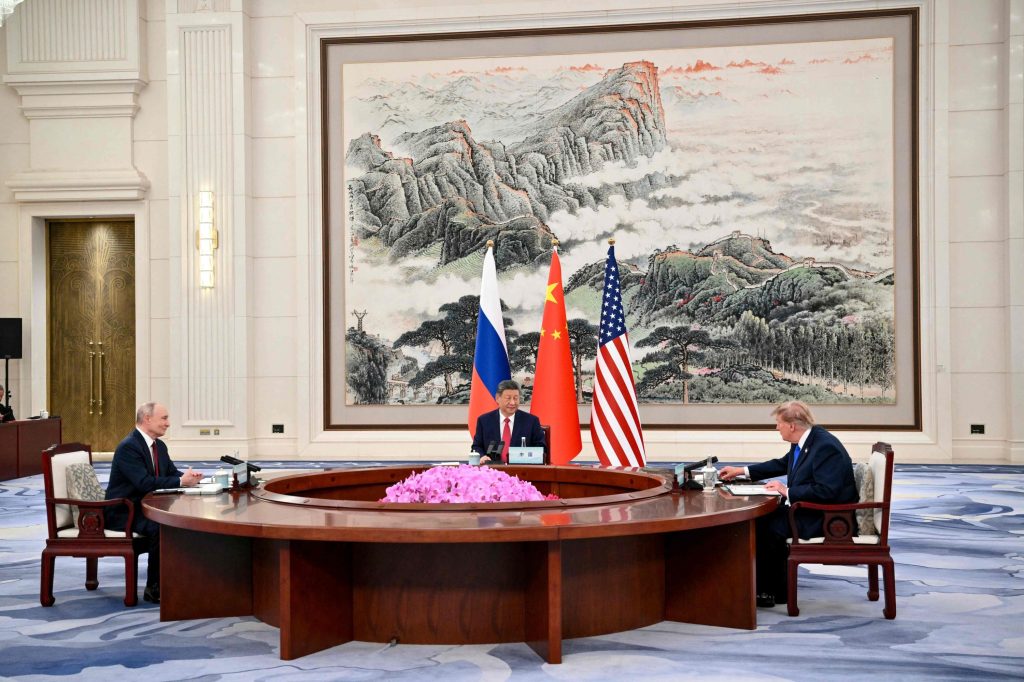
On 19 November 2026, in Shenzhen, Xi Jinping, Vladimir Putin and Donald Trump presented the world with a ‘Canada Dry’ Yalta: one is reminded, in fact, of the famous advert for a soft drink that looked like alcohol, smelled like alcohol but was not alcohol. The same illusion was repeated in China a few days ago. At the Yalta Conference on 11 February 1945, amidst the ruins of a war-torn Europe, three victors divided up the world. In Shenzhen, seventy years later, there are at least three reasons why this meeting resembles a shadow play: Europe is a major power and China’s leading trading partner; together they account for 30 per cent of world trade and 33 per cent of global wealth. None of the three powers present in China can claim victory in any conflict whatsoever, starting with Russia in relation to Ukraine and the United States regarding Iran.
Finally, these three old men have not divided anything amongst themselves at all: the Ukrainians are fighting back like wild beasts, the Europeans are organising themselves without the United States, and the rest of the world – which, after all, comprises 5 billion people compared with barely 2 billion for the three decrepit powers in Shenzhen – has no intention of allowing itself to be caught in the nets of this unnatural alliance.
Unnatural, for that is indeed the first lesson Europeans can draw from this summit: Donald Trump continues to destroy the West. He has been doing so conscientiously since his election, trampling underfoot the principles and values of Western democracies. But on this trip he has added yet another strategic rift: his handshake with his ‘friend’ Vladimir Putin smacks as much of indecency as it does of betrayal. It is high time for Europe to shake off its Atlanticist delusion and build an autonomous European defence. The European pillar within NATO is itself an illusion if the aim is to split NATO in two: a conventional force ready to fight in Europe, formed with and led by Europeans, without the Americans, and a nuclear deterrent as a last resort in the hands of the United States. This is indeed one of the proposals currently under discussion at the Pentagon 1, and for Europe, it would mean the certainty of fighting alone in a devastating war on European soil.
The second lesson concerns our identity as Europeans: far from complaining or regretting not having been invited to Shenzhen, we should, on the contrary, be proud of it and more determined than ever. The three leaders – from China, Russia and the US – represent, in fact, everything we detest and are trying to combat: authoritarianism, protectionism and the use of force. Their final declaration may well be skeletal, but it reveals their complicity: they assert the ‘principle of state consent’ and the ‘immunity’ of heads of state from the International Criminal Court, which must not ‘abuse’ its powers. They propose to ‘increase the production and supply of refined petroleum products’, without any reference to climate protection. They appear to accept the role of the United Nations in maintaining international peace and security, but call for a ‘reform’ about which nothing is known. As for their statement on global nuclear stability and the fight against proliferation, it is rife with ambiguities, particularly regarding the French and British deterrents which Russia and China have been attempting to control ever since the inception of arms control.
The Europeans, by contrast, exemplify and advocate for a world based on three opposing principles: democracy, reasoned liberalism, and respect for the rule of law. And we are not alone. On the continent, the European Political Community (EPC) brings together more than 47 countries that share, to a greater or lesser extent, these principles. The Coalition of the Willing for Ukraine comprises 37 European countries, joined by Canada, Australia, New Zealand, Iceland and Japan. None of these countries is prepared to accept aggression by one country against another as normal or commonplace. Nor is there a single one that accepts belonging to spheres of influence determined and imposed through the complicity of the three outcasts of the world order. In Latin America, Lula’s recent victory as President of Brazil also demonstrates that history is not frozen in the authoritarian inevitability embodied by the ‘Shenzhen Three’.
The third lesson is that there are winners and a loser in this affair. The loser is undoubtedly Donald Trump, like a rabbit blinded by the lights of the show, fleeing the American stage where he has just suffered a resounding electoral defeat, and signing a declaration with China and Russia that is as insipid as it is undignified. Vladimir Putin, by contrast, has secured a spectacular diplomatic victory, finding himself – a pariah wanted under an International Criminal Court warrant – alongside his two new major strategic allies: China, of course, but now also the United States. As for China, it has secured its status as an ‘indispensable nation’ at this summit. This is how Madeleine Albright defined American power in 1998: ‘we are the indispensable nation’. As the chief architect of the Shenzhen summit, Xi Jinping has seen his status as a major power reinforced. He might even adopt the closing words of Bill Clinton’s Secretary of State: ‘We hold our heads high and look further into the future than other countries.’
Two words should therefore sum up the Europeans’ response: carry on and move forward. Carry on defending Ukraine against Russian aggression; make progress towards Europe’s strategic independence, including outside NATO. Russia and Trump’s United States have, in fact, become our two adversaries in cahoots: how can we still trust NATO to defend us (and possibly Ukraine) against Russia, when the Alliance’s supreme commander, Donald Trump, embraces the persona, views and imperial ambitions of the Russian president?
Footnotes
- The US Under-Secretary of State for War, Elbridge Colby, consistently refers to a ‘European-led conventional defence’ within NATO. ↩︎