The new EU Climate Resilience Framework: a timely initiative, but does it go far enough?

Authors
 Samuel Elrington Intern at the Energy Centre

On October 27th, the Commission presented its long-awaited EU Framework for Climate Resilience, aimed at strengthening Europe’s ability to anticipate, prepare for, and manage climate risks.
The summer of 2026 offered a stark reminder of why such a proposal is urgently needed. Western Europe experienced its warmest summer on record, with heat causing a record 50,000 excess deaths across European cities, including more than 8,000 in France alone. Wildfires burned approximately 700,000 hectares of land across the EU, around 79% above the 2006-2025 average. Meanwhile, exceptionally low water levels in major European rivers, including the Rhine, Danube and Loire, disrupted transport, energy production and water availability. The economic toll was equally striking, with this year’s heatwaves estimated to have cost around €113 billion in annual output across 30 EU countries.
These figures expose a simple truth: that the continent is not sufficiently prepared for the impacts of climate change. The Commission’s new framework seeks to address this challenge by shifting the EU’s approach from reacting to disasters towards anticipating future risks, strengthening preparedness and preventing avoidable damage.
The package includes a legislative proposal, the European Climate Resilience Law, an accompanying Communication, and a set of digital tools – notably the European Climate Viewer – designed to provide up-to-date information on climate hazards and available resilience measures.
The framework arrives while governments are still counting the cost of this summer’s extreme weather. Few would argue that it comes at a moment too soon. But will this new framework deliver the step change Europe needs?
The EU’s current approach: fragmented, and falling short
The new framework does not build from scratch. The EU already has a Climate Adaptation Strategy, adopted in 2021, which encourages national authorities to develop ‘smart’ and more systemic climate adaptation strategies. It also provides guidance to public authorities to better prepare and implement adaptation solutions through the Climate-ADAPT website run by the European Environmental Agency (EEA).
Several EU legislative acts impose adaptation obligations on Member States. The European Climate Law requires them to adopt and implement national adaptation strategies (NASs) and plans (NAPs), and the Governance Regulation requires national energy and climate plans (NECPs) and long-term strategies to include adaptation goals. There are also obligations imposed by sector-specific laws. The Floods Directive, for instance, requires Member States to regularly update flood hazard and risk maps, while the Critical Entities Resilience (CER) directive requires them to develop national strategies for critical infrastructure.
Yet these requirements remain poorly coordinated, creating overlapping and fragmented reporting obligations. Worse, they have not driven adaptation planning and implementation at the scale the risks require.
Member States rely on different climate projections and apply varying criteria to assess climate risks, which makes their assessments hard to compare. In addition, many public authorities continue to rely on historical climate data when planning investments, rather than on future climate scenarios. These gaps leave Europe’s preparedness short of the scale and complexity of the climate risks ahead.
A common approach to climate risk management
The new framework seeks to address these shortcomings by promoting common methodologies to assess and manage climate risks. One of the central elements is the introduction of a common reference warming scenario (1.5°C by 2030, 2°C by 2050, and 3°C by 2100, relative to pre-industrial levels) which should serve as a common anchor for assessing climate risks and planning decisions at all governance levels. While it draws on the IPCC’s AR6 and advice from the European Scientific Advisory Board on Climate Change, it adopts a precautionary approach, using warming projections consistent with current mitigation policies rather than relying on more optimistic scenarios in which all climate pledges are fulfilled.
The Law would replace the four planning instruments required today by a single national strategic plan on climate resilience in each Member State. These plans would build on national climate risk assessments that are updated every five years, and which are based on the common reference warming scenario, making them consistent and comparable. Each plan would have to set objectives and measurable targets for the different policy areas, such as energy infrastructure, transport, water, and land planning, among others.
The framework also introduces the concept of ‘risk owners’, where Member States would have to identify in their national plans the competent authority responsible for managing each identified climate risk, with the aim of avoiding diffuse responsibility. This addresses a weakness that many have highlighted: without clear ownership, climate risks can be left underdressed, with the cost of inaction falling on society. To be effective, however, it will have to clearly outline how governments select risk owners and what this will mean in practice, including their specific requirements and the accountability measures if they fail to act.
While the introduction of these common methodologies and planning tools is welcome, the first national climate resilience plans will not be adopted before 2028. Besides, the proposed Law stops short of making the common reference scenario a legally binding obligation for all public authorities. While the Commission intends to apply it in relevant planning works, impact assessments, spending programmes, and investment decisions, Member States are only required to “encourage” public authorities to take the trajectory into account when exercising public functions. The proposal states that it should serve as the baseline assumption but does not impose a universal legal requirement to use it in every public investment decision. Without a binding requirement, nothing prevents a climate-sceptic government from ignoring the reference scenario once in office. The result could be a reversal of national ambition and growing misalignment between Member States.
Supporting measures: access to knowledge will not solve implementation gaps
Beyond establishing common methodologies and clarifying responsibilities for managing climate risks, the framework includes a range of online tools and supporting measures to help national and sub-national authorities plan and implement climate resilience actions.
The most prominent initiative is the European Climate Viewer, an online tool designed to provide policymakers and investors with accessible information on climate hazards. By helping users identify their exposure to future climate risks, it should make it easier to incorporate climate resilience considerations into investment and project planning. There is also a Navigator of Climate Resilience Tools, which builds on the existing Climate ADAPT website and aims to help public authorities and business identify the tools most relevant to their needs.
However, better access to information will not, on its own, resolve existing weaknesses in planning and implementation capacity. Many local and regional authorities lack the technical expertise and administrative resources needed to translate climate risk assessments into concrete investment projects. They will therefore also need advisory support for project preparation, targeted financial assistance and opportunities for peer learning. Without this support, there is a risk that the benefits of the new tools will remain concentrated among larger administrations and better-resourced regions, precisely where the capacity to assess and manage climate risks is already greater.
Measures to close the insurance protection gap
The framework also recognises the widening gap between the economic losses caused by natural disasters and the share covered by insurance, known as the insurance protection gap. Across the EU, only around 25% of natural catastrophe losses are insured, leaving households, businesses and public authorities exposed to high levels of uninsured costs. This protection gap is unevenly distributed: over 1980–2024, 15 EU Member States insured less than 10% of their natural catastrophe losses. Italy, for example, recorded the EU’s second-highest absolute losses, at €145 billion, yet only 4% of these losses were insured (Figure 1).
Figure 1 – Economic losses caused by weather-and climate-related extreme events (1980-2024) – per MS
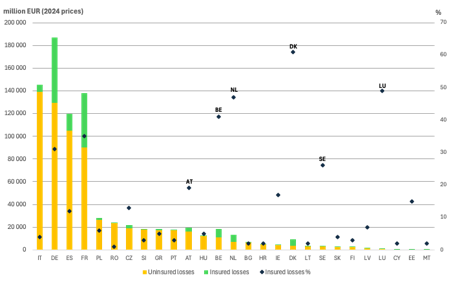
Source: JDI based on EEA (2025).
Notes: All EUR amounts are expressed in 2024EUR
To address this challenge, the Commission will set up a Climate Insurance Alliance by the end of 2027, bringing together insurers, reinsurers, intermediaries, policyholders, risk-modelling experts, investors, the European Insurance and Occupational Pensions Authority (EIOPA) and public authorities. The Alliance is expected to propose a set of measures to increase insurance uptake, strengthen incentives for prevention through products that reward risk reduction (e.g. impact underwriting) and support “build-back-better” reconstruction, and assess whether insurance capacity, including reinsurance and catastrophe bonds, can cover the growing climate risks.
The framework also assigns EIOPA a role in establishing an Observatory for Catastrophe Risk Insurability. Working with the Commission and the insurance sector, EIOPA will further develop its PROTECT tool to help property owners understand climate risks and identify preventive measures. The Observatory is intended to improve the data and metrics needed to identify the drivers of the protection gap, track its evolution and inform policy responses.
While the Insurance industry has welcomed the establishment of the Climate Insurance Alliance, some NGOs and experts consider that the alliance will not close the insurance gap without stronger action, including the establishment of an EU public-private re-insurance scheme to support solidarity against catastrophes, as proposed by a 2024 ECB-EIOPA paper. The paper also proposed to introduce a reinsurance scheme where fund payouts would be conditional on the implementation of risk mitigation measures. The Communication indicates the intention to ‘explore’ public-private partnerships at national or European levels, but there is no specific commitment to study the feasibility of these proposals.
Financing Europe’s climate resilience: who pays?
The framework acknowledges the scale of investment required for climate adaptation but offers few concrete proposals to mobilise the public and private finance needed to achieve it. The main financial commitment is the announcement of at least €30 billion in EIB Group financing for climate adaptation between 2026 and 2030. While significant, this commitment should be seen against the EIB Group’s broader ambition to support €1 trillion in investment in climate action and environmental sustainability over 2021–2030. Adaptation investments would represent only around 4.5% of the bank’s total investment in climate action.
At the EU level, the Communication recalls that various 2028–2034 MFF programmes – such as the National and Regional Partnership Plans (NRPPs), Horizon Europe or the European Competitiveness Fund – can provide support to climate resilience. Yet it makes no concrete commitment to steer them towards resilience, for instance when negotiating NRPPs with Member States or drafting ECF work programmes. The only specific commitment concerning the next MFF is to clarify how climate adaptation considerations should be taken into account when applying the ‘Do No Significant Harm’ (DNSH) principle to investments exposed to climate hazards.
At the national level, there are some measures to incentivise public support to resilience investments. This includes the possibility of exempting certain public support to companies investing in climate resilience from State aid requirements. The Communication also suggests using tax incentives to encourage private investment, drawing on the approach developed under the Clean Industrial Deal. These could include tax credits and accelerated depreciation, allowing companies to deduct the cost of eligible investments in resilient infrastructure more quickly, thereby making private adaptation investments more attractive.
Overall, these proposals remain relatively general. The framework recognises the need to increase public and private investment on resilience but relies mainly on existing funding instruments. Some observers have criticised the absence of a dedicated European Climate Adaptation Fund, as proposed by the Spanish governments several months ago. Yet, with negotiations on the 2028–2034 MFF already under way, this was hardly a realistic option. What the Commission could have done, however, was to commit to improving how EU funds are planned and implemented to ensure that they effectively contribute to building resilience. Various studies have highlighted significant shortcomings in this respect, where EU-funded investments rely too often on historical climate data rather than forward-looking climate projections, favour short-term fixes over longer-term transformative solutions, and allocate resources according to geographical criteria rather than actual climate risks and needs. The Commission could have addressed these shortcomings by proposing stronger requirements for the programming and implementation of EU funds, as proposed in a recent report for the European Parliament.
Conclusion: a step forward, but not yet the step change Europe needs
The new EU Climate Resilience Framework is a promising step towards a more coordinated risk assessment and better-targeted adaptation measures at EU and national level. It recognises that adaptation can no longer be treated as a collection of separate national and sectoral policies, and must become an integrated priority across EU policymaking and investment decisions. The common reference warming scenario, simplified national planning requirements and greater attention to risk ownership are important steps towards more coherent and forward-looking climate risk management.
Yet the framework’s impact will depend on its ambition in the legislative process and on implementation by Member States. A binding obligation to use the reference scenario, clearer accountability for risk owners and financial incentives linked to national plans would turn good intentions into enforceable commitments. Without them, the framework risks remaining a step forward rather than the step change Europe needs.
Authors
- Samuel Elrington Intern at the Energy Centre