Trump and the purchase of Greenland: bluff?
Authors

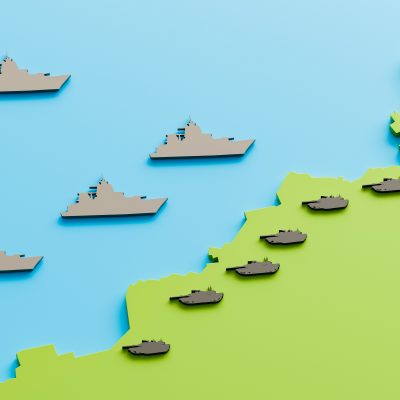
In the Oval Office on 21 January and before the press, President Trump reiterated his intention to acquire Greenland for reasons of «international security», referring to threats from China and Russia, whose ships patrol the area.
Without ruling out the use of military force, he also stressed that possession of this territory was very costly for Denmark. His eldest son made a short visit to Greenland before the investiture on 20 January.
- Greenland, between autonomy and dependence
A little historical background seems necessary. After the Vikings, the Inuit peoples arrived in the 13th century. In the 18th century, the Kingdom of Denmark and Norway established its sovereignty over the island. In 1814, Greenland became a Danish colony, then part of the Kingdom of Denmark in 1953. In 1973, Greenland joined the European Economic Community (EEC) along with Denmark. In 1979, the latter granted internal autonomy to Greenland.
But in 1982, in a referendum, a majority of the population voted in favour of Greenland’s withdrawal from the EEC. In 1983, Denmark signed an amending treaty with the EEC to clarify the situation in Greenland, including specific provisions to protect fishing. Greenland is placed on the list of overseas territories associated with the EEC (now the European Union).
In 2008, a new (consultative) referendum approved the prospect of greater autonomy by 75%, with the Danish Parliament passing a law in 2009 to confirm this greater autonomy. Denmark is ceding 32 areas of jurisdiction, including police and justice, to its former colony. Foreign policy, monetary policy and defence remain under Danish control.
- Complex links with the European Union
Greenland, which is autonomous but part of the Kingdom of Denmark (subject to the Danish Constitution and Supreme Court), is not strictly speaking an EU territory. But Greenlanders are indeed European citizens. The territory retains important links with the EU. It is one of the 13 Overseas Countries and Territories (OCTs) which have constitutional links with an EU Member State (this is the case for New Caledonia and Saint Pierre et Miquelon in France, for example). European law does not apply in these territories, which are not members of the Schengen area.
The OCTs are nevertheless involved in certain EU policies to facilitate their development. This means that products imported into the EU from the OCTs are not subject to customs duties or quantitative restrictions. Their nationals have European citizenship, and therefore an EU passport.
- Why is Greenland so coveted?
The territory is 4 times the size of mainland France, and 85% of it is covered in ice (the largest island in the world). It is home to around 55,000 people, whose livelihood is based mainly on fishing (95% of exports).
The country’s economy is therefore mainly based on the fishing industry, a booming tourism sector and limited mining activity. The public sector accounts for around half of national employment. Denmark’s financial support accounts for half of public revenue, and in terms of trade, 50% of exports go to Denmark and 60% of imports depend on it.
It is estimated that Greenland is warming twice as fast as the rest of the world, causing the ice to melt. This could open up new trade routes that were previously inaccessible. The land is teeming with oil and gas (13% of undiscovered oil and 30% of undiscovered natural gas is believed to be in the Arctic, most of it in Greenland).
It has rare earths and metals such as nickel and cobalt, which are needed to make batteries. But these resources have been exploited very little to date, due to the Danish government’s view that such exploitation would be very harmful to the environment. On the other hand, “the big challenge is the cost of extracting mineral resources. The mines are far from anywhere and much of the country is covered in thick ice”, according to Friis Arne Petersen, former Danish ambassador to the United States, China and Germany (interview in Le Figaro, 24 January 2025).
The American group Alcoa had planned to set up a large aluminium plant with an investment of around 3 billion euros, but came up against Denmark, which believes that the production of greenhouse gases should be penalised. However, some American companies, including the mining company KoBold Metals, backed by Bill Gates and Jeff Bezos, are already investing in Greenland. Similarly, in the south of the island, the Australian company Greenland Minerals and
Energy Ltd has discovered what could be the world’s largest deposit of rare metals, but here again it is coming up against the Danish authorities, who see this exploitation as a threat to the environment and to traditions.
It should be noted that Russia is currently undertaking remilitarisation in the Arctic, and that China is seeking to increase its investments.
- Strategic importance for the United States
As early as 1867, the United States made an offer to buy Greenland and Iceland, which was renewed in 1910. In 1946, President Truman offered 100 million dollars to buy the island. But Denmark, which had regained control of the territory after the war, refused. In 2019, Trump repeated his offer to buy Denmark, but Denmark replied that it was not for sale. In 2021, Anthony Blinken announced that the United States were no longer interested.
The US army maintains a permanent presence at Pituffik air base (formerly Thule base), as Greenland is crucial to the ballistic missile detection system, as the shortest route between Europe and America passes through the island. This base is part of the United States Space Force, which was founded on 20 December 2019.
In 2004, Denmark signed an agreement with the United States authorising the reinforcement of this NATO-integrated base for the modernisation of the anti-missile system.
- What about tomorrow?
BUYING
Under international law, one state can buy another if the target state (in this case Denmark) agrees. We remember the acquisition of Corsica by France in 1768, Louisiana by the United States in 1804, and Alaska ceded to Russia in 1867.
The only limit to this type of operation is the domestic law of each country. This may require consultation with the population concerned. If the consultation fails, the operation cannot go ahead.
The Danish government and the Prime Minister of Greenland, Mute Egede (who is also in favour of independence) have reiterated several times in recent weeks that Greenland is not for sale. According to the second, “Greenland is open for business, but not for sale”.
The prospect of using military force would also come up against the fact that the United States and Denmark are NATO allies. As Elisabeth Svane, chief political correspondent for the Danish newspaper Politiken, was quoted by the BBC as saying, “If the US invades Greenland, it invades NATO. Article 5 should be triggered: if a NATO country invades a NATO country, there is no more NATO”.
In reality, Article 5 is the solidarity clause, not the end of NATO. This is an unforeseen scenario since, without Article 5, if one ally attacks another there is no longer any alliance. But with Article 5, we can assume that the other allies will intervene.
Finally, Denmark could also invoke Article 42.7 of the Treaty on The European Union (mutual defence clause), a clause from which Greenland benefits. But here again the question arises of the determination of European countries to intervene against an ally, the United States?
Greenland is also due to hold elections in the spring of 2025, with one of the main issues being whether the country should become independent (the current Socialist Prime Minister is in favour), with a possible referendum at a later date. If this possible future referendum was to result in a yes to independence, the Danish parliament would then have to give its assent, which is likely today, as only two minor parties have indicated that they would oppose it. The independence movement remains strong in Greenland.
At this stage, however, there is still a great deal of disagreement over the details of such a referendum. Even in the event of independence, in the more or less distant future, the prospect of a purchase by the United States therefore seems almost unthinkable, especially as the five parties that sit in the Greenland parliament have just unanimously rejected the annexation proposed by Donald Trump.
BUSINESS
This is a plausible option, meaning at the very least a greater presence of American companies on Greenland to exploit its resources, or in the event of future independence, an economic cooperation agreement between Greenland and the United States.
But until further notice, this option is not favoured by the Danish government, for reasons linked in particular to environmental policy. Only a change in the direction of public opinion in Greenland could change the situation. In any case, the population is very cold, if not icy, and above all worried about the statements made by the new American president.
Greenland’s future is therefore primarily in the hands of its people. Greenland’s prime minister told a press conference on 21 January that if the UnitedStates wanted to talk about Greenland, it should do so directly with Greenland. He called for calm and asked for a meeting with President Trump. But until independence is achieved, the Kingdom of Denmark and its government will continue to play a major role in the economic and political choices that are made.
The latter is likely to face a complex situation in the future, especially if the United States seeks to blackmail it over possible trade retaliation.