What might an ‘alliance of middle powers’ look like?
In his remarkable speech at the World Economic Forum in Davos, Mark Carney, Mark Carney, the Canadian Prime Minister, proposed building an alliance of ‘middle powers’ to protect the planet from a return to the logic of « might makes right » imposed by the global giants, China and the United States. Alongside Canada, the European Union must take the lead in implementing such a project.
Bringing together the G7 countries minus the United States and the countries of the Global South
But what could this ‘alliance of middle powers’ actually look like in practice? It would involve bringing together, on the one hand, the developed countries that refuse to align themselves with Donald Trump, basically the G7 minus the United States, and, on the other hand, the many countries of the ‘Global South’ that do not want to be vassals of either Xi Jinping’s China, allied with Russia and Iran, or Donald Trump’s United States.
Its objective should not, and in any case could not, be a return to a fantasised golden age of multilateralism and international law. If post-war multilateralism is collapsing so easily today, it is also because it never worked well and had become profoundly unsuited to the new global situation. Built before the great wave of decolonisation in the 1950s and 1960s, it did not give the countries of the Global South their rightful place, particularly in the Security Council and international financial institutions.
The United States has never really accepted multilateralism
Long before Donald Trump, the United States never truly accepted the multilateralism that it had helped to create after the Second World War. It never joined the International Court of Justice or the International Criminal Court; it does not provide Blue Helmets for UN peacekeeping missions; it has never agreed to apply the eight core conventions of the International Labour Organisation at home; for many years, it has blocked the functioning of the World Trade Organisation by refusing to appoint judges to the dispute settlement body; it did not wait for Donald Trump to block international action on climate change for a long time by refusing to ratify the Kyoto Protocol; and it has constantly criticised and threatened to cut off funding to the United Nations itself, UNESCO, the WHO, etc.
The DNA of the European Union is multilateral
Europe and its main member countries, on the other hand, have always been committed to multilateralism. This was in line with the DNA that had presided over the birth of the Union itself.
Militarily weak and now lacking the capacity for imperial projection in the world, Europe knows that its fate and its future are inextricably linked to the existence of international law capable of protecting ‘middle powers’ like itself from the encroachments of the powerful.
But it has procrastinated for thirty years, turning a blind eye to double standards, particularly on the part of the United States. And it has been unable to build a solid alliance with the countries of the “Global South” in order to renew and strengthen multilateralism.
This would certainly have meant that Europeans, particularly the United Kingdom and France, would have had to give up their privileged positions in the Security Council and the International Monetary Fund.
Europe must act urgently
The current situation now requires Europe to act urgently if it does not want to be crushed by the pincer movement formed by Trump on one side and the Xi-Putin alliance on the other, which is closing in on it. By keeping a low profile since January 2025 in an attempt to appease Trump, with the success we all know, the European Union has just lost a year in reconfiguring itself in the new world order. It must seize without delay the project of an ‘alliance of medium powers’ put forward by Mark Carney and help turn it from concept into reality.
Its multilateral DNA gives it credibility and a real chance of success if it throws itself fully into this venture. Moving closer to Canada, Japan or South Korea should not be too difficult. Bringing the countries of the Global South on board will certainly be more challenging.
Many of them are being courted assiduously by China and Russia, particularly within the framework of the BRICS. And the EU must fully assess what it means for it to embark on this path.
Building such an alliance requires the EU to change its stance on several sensitive issues
Firstly, the ‘Fortress Europe’ migration policy currently prevents any real strategic rapprochement with our neighbours in the southern Mediterranean.
Similarly, the support given since October 2023 to Benjamin Netanyahu’s government, despite the war crimes and crimes against humanity committed in Gaza and the constant violations of international law in the West Bank, has deeply discredited the European Union in the rest of the world by casting doubt on the reality of its commitment to international law.
In order to have any chance of building such an ‘alliance of medium powers’, the EU will necessarily have to evolve on these two issues.
Similarly, both in terms of traditional development aid and of green finance needed to help countries in the South adapt to climate change and accelerate their own energy transition, the European Union and its Member States will have to be prepared to dig deep into their pockets if they really want to save multilateralism, and in particular concerted international action against global warming, despite the desertion of the United States.
The economic dimension of the ‘alliance of middle powers’
Finally, such an ‘alliance of middle powers’ will also need to have an economic dimension in order to help its members, both developed countries and countries of the ‘Global South’, reduce their excessive dependence on both China and the United States. However, this will require agreeing to develop closer economic relations between developed countries and countries of the South that are part of this alliance, and therefore to enter into agreements such as the one, now highly contested, concluded between the EU and Mercosur. If, due to its internal divisions, the European Union is unable to embark on such a project with sufficient determination, its main Member States – France, Germany, Spain, Italy, Poland and the Netherlands – will have to take over with Canada.
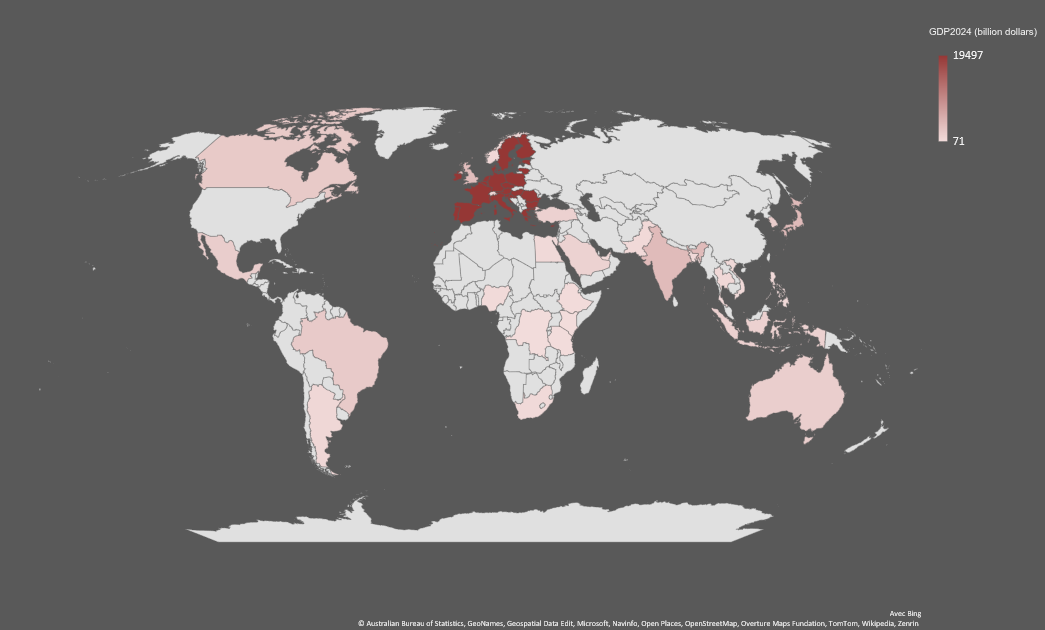
Assuming, then, that the EU is really prepared to move in this direction, to whom should it send invitations? If we set aside the United States on the one hand and China, Russia and Iran on the other, and focus on the 20 other most populous countries on the planet and the 20 other countries with the highest GDP, we end up with a total of 29 countries1 (including the European Union as a whole).
Source: World Bank and United Nations
Such an alliance would bring together six African countries (South Africa, Democratic Republic of Congo, Ethiopia, Kenya, Nigeria and Tanzania), two Latin American countries (Argentina and Brazil), two North American countries (Mexico and Canada), two East Asian countries (Japan and South Korea), three South Asian countries (Bangladesh, India and Pakistan), five South-East Asian countries (the Philippines, Indonesia, Singapore, Thailand and Vietnam), four European countries and entities (in addition to the EU itself, Norway, Switzerland and the United Kingdom), four Middle Eastern countries (Saudi Arabia, Egypt, the United Arab Emirates and Turkey) and one Pacific country (Australia).
Balanced global coverage
This would therefore provide fairly balanced global coverage, both in terms of continents and the distribution between developed countries and countries in the ‘Global South’. Of course, the major regional organisations that are partners of the EU, such as CELAC, ASEAN and the African Union, would also need to be included. This would remain a manageable format, as the number of participants would be little greater than the current membership of the European Union itself.
Source: World Bank and United Nations
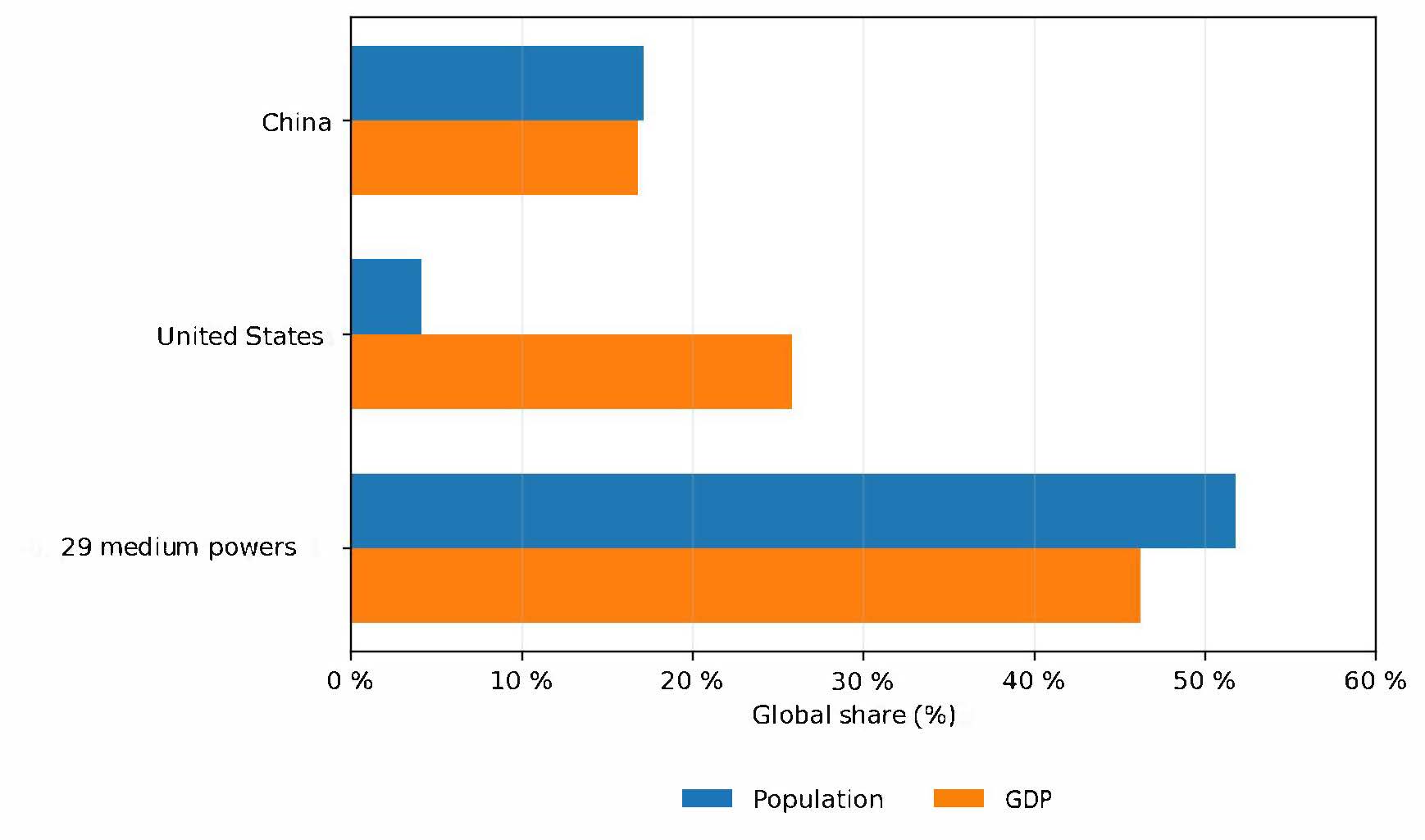
Together, these countries account for 52% of the world’s population and 46% of global GDP, compared with 17% of the population and the same percentage of global GDP for China, and 26% of GDP and 4% of the world’s population for the United States. In other words, this group would carry more weight than these two global superpowers combined in each of these two dimensions. This would give them a strong voice if they succeed in building such an alliance. All that remains is to do it…
Authors

Other publications on same theme
 Blog post
Europe faced with the war in Iran