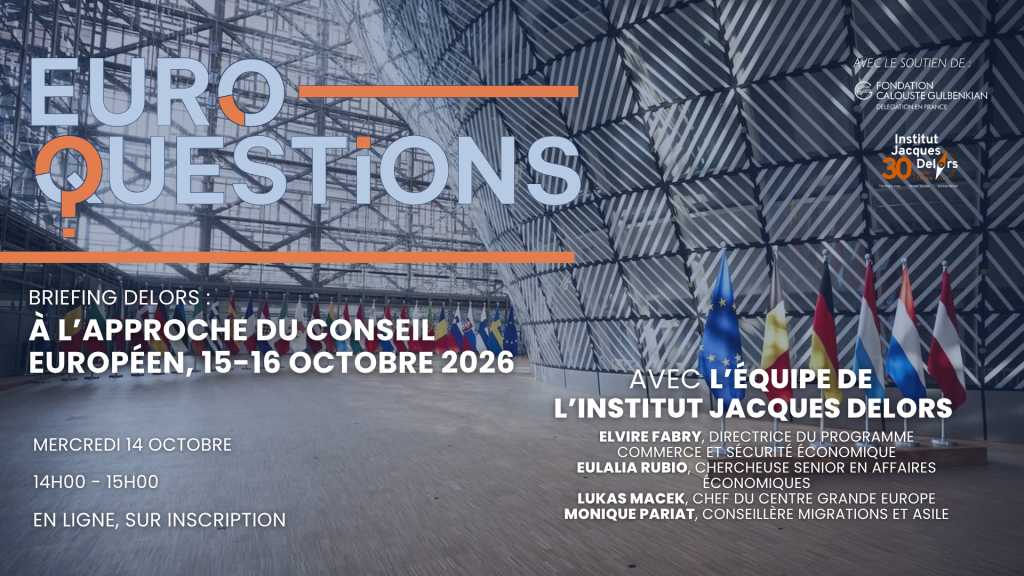
EuroQuestions | Delors Briefing: Ahead of the European Council, 15–16 October 2026, with the Jacques Delors Institute team
Online
Speakers




EuroQuestions : Season 2026, Episode 16
*This EuroQuestions will be in French
Date / Place: 14 October 2026, 2:00–3:00 p.m. (CET), online (registration required)
Title:
Delors Briefing: Ahead of the European Council, 15–16 October 2026
Background:
The Jacques Delors Institute is launching a new format within its EuroQuestions series: Delors Briefing: Ahead of the European Council.
This one-hour session will bring together four experts from the Institute to provide the key elements needed to understand the context in which the European Council is taking place: What is on the agenda? What positions are emerging? Where do negotiations stand? And what are the main issues at stake?
On 15 and 16 October 2026, this European Council will be a key moment for setting the European Union’s main priorities through the end of the year:
- As negotiations on the next Multiannual Financial Framework (2028–2034) intensify, Member States will need to start clarifying their priorities and positions on the future of the EU budget. Eulalia Rubio, Senior Research Fellow in European economic affairs at the Jacques Delors Institute, will provide an overview of the state of negotiations and the key issues to watch.
- European competitiveness and trade relations will also be at the heart of discussions, as the EU faces an increasingly challenging trade environment and strategic dependencies on both the United States and China. Elvire Fabry, Senior Research Fellow at the Jacques Delors Institute, will examine the issues surrounding trade and economic security.
- Migration will remain a major political issue, particularly following the unprecedented influx of migrants into Ceuta this summer. Following the entry into force of the Pact on Migration and Asylum, and as Member States now begin implementing its new rules, Monique Pariat, Adviser on Migration and Asylum at the Jacques Delors Institute, will analyse the different positions and next steps.
- Finally, enlargement will also be high on the European agenda. As negotiations with several candidate countries progress at different speeds and new proposals emerge regarding relations between the EU and its partners, Lukas Macek, Director of the Wider Europe Centre, will discuss the state of the process and the political issues surrounding it.
In one hour, the Briefing Delors will provide the key elements needed to understand this European Council: its broader context, the positions at play, the state of negotiations and what could unfold around the table.
Questions to answer:
- What elements of the current geopolitical context are likely to shape this European Council?
- On each of the agenda items, what are the main points of disagreement, and between which Member States?
- What is France’s position on these issues, and how does it compare with those of other Member States?
Speaker(s):
Elvire Fabry, Director of the “Trade and Economic Security” programme, specialises in the geopolitics of trade, EU trade policy and EU–US and EU–China relations. She is also a member of several scientific and advisory boards, including those of CEPII and the Real Instituto Elcano.
Lukas Macek, Director of the Wider Europe Centre at the Jacques Delors Institute, specialises in Central and Eastern Europe and has been Director of the European Undergraduate Programme at Sciences Po Dijon, where he has taught since 2004. He took part in the work of the Convention on the Future of Europe and has been involved in European affairs in the Czech Republic.
Eulalia Rubio, Senior Research Fellow at the Jacques Delors Institute, specialises in the EU budget, EU fiscal policy and European public investment. She has worked in particular on the post-Covid recovery plan, the role of the European Investment Bank and the financing of the green and industrial transitions.
Monique Pariat, Adviser on Migration and Asylum at the Jacques Delors Institute, was previously Director-General of the European Commission’s Directorate-General for Migration and Home Affairs. She led work on the Pact on Migration and Asylum, as well as on European border and internal security policies. She also contributed to the creation of rescEU, the European strategic reserve of crisis response capacities.
What are EuroQuestions?
EuroQuestions are 30-minute online discussions held two to three times a month, bringing together a moderator (either Christine Verger or William Malaterre) and a guest speaker to discuss a pressing European issue. The guest speaker typically delivers a 15–20-minute presentation, followed by a 10-15-minute discussion with the moderator.
Online