Franco-German defence cooperation: avoiding false debates
Authors

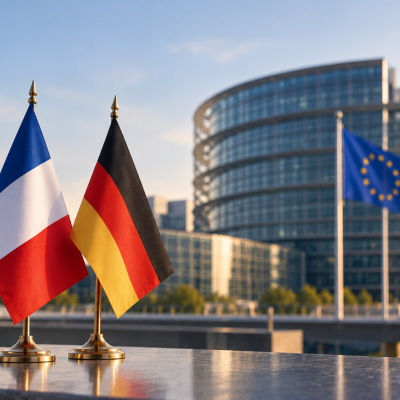
France and Germany’s trajectories in terms of defence investment are crossing each other1. This reality is reflected in the trend of their respective armament budgets (NATO figures): in 2018, France spent twice as much as Germany on defence procurement (€10 billion and €5 billion respectively); by 2024, the figures were almost on a par (17 and 18 billion); projections for 2030 indicate that German funding for defence industrial investment will then be double that of France (estimates: 25 and 50 billion). This financial shift is shaking the foundations of the bilateral relationship in this field and calling into question the industrial balance that had hitherto governed cooperation between the two countries. It comes at a time when the geopolitical context of defence in Europe has changed radically and when the operational analysis of military requirements is undergoing fundamental revisions, particularly in the wake of the war in Ukraine.
In the face of mounting risks and US disengagement, Germany’s military build-up is good news for European defence, and for France’s defence in particular. However, the question arises as to the path this rearmament should take in order to contribute to Europe’s defence autonomy and to its ability to deter aggressors. The challenge, therefore, is to ensure that the announced investment funds are used in a way that supports the development of a European industrial base capable of meeting this dual objective. This ambition cannot succeed without upgrading the bilateral relationship – one built on compromise around shared interests and extended to the European level.
Do not dwell on the illusory failures of major bilateral cooperation projects
The litany of flagship projects, such as the FCAS or the MGCS, which have been called into question or halted, cannot be used as an argument to bury any prospect of Franco-German cooperation in the defence sector.
Let us first note that these major programmes were launched in 2017 in a context completely different from the one we face today. The aim at the time was to initiate cooperation to develop a new generation of systems to replace existing capabilities, but which neither partner had the capacity to fund alone: tanks, fighters and maritime patrol aircraft, attack helicopters, surveillance drones, etc. These requirements must be reassessed in the light of new operational realities and of what should probably be a different allocation of priorities. We know, for example, that a larger proportion of resources is now devoted to the production of equipment rather than to the development of future complex and costly systems.
Furthermore, the work carried out as part of these projects was not in vain, as it fuelled technological advances and institutionalized channels of communication between the general staffs and defence procurement agencies of both countries. Discussions on technical and operational analysis thus often led to a common definition of requirements.
But lessons must be learnt from these deadlocks: it must be acknowledged that industrial rivalries have prevailed over the political will to cooperate on programmes that lie at the heart of defence policy, for which the States bear democratic responsibility. How to overcome this difficulty in the future is a crucial question that must command the attention of both governments.
It is therefore pointless, as we have seen in both Berlin and Paris, to issue condemnations that shift the blame for failures onto the partner, to conclude in the end that nothing can be achieved with him. It is also important to recall that behind these halted mega-programmes lie numerous projects in which industrial players and research teams from both countries work together, including on strategic capabilities such as early warning, and often through programmes co-funded by the European Union.
Finally, the reorientation of shared priorities is influenced by the US stance, which threatens to cut off some supplies or restrict their freedom of use. These restrictions may also be linked to the US industry’s inability to supply equipment to customers other than the Pentagon, whose orders are rising considerably as a result of Trumpist policy. This is leading, for example, to a shift towards European suppliers for essential capabilities such as air defence and surveillance.
Overcoming industrial rivalries
Rising military budgets benefit companies in markets that are primarily domestic, as the customers remain at the end the ministries of defence. Competition rarely extends beyond national borders, and the industry is capitalising on this fragmented system, which ensures it a form of monopoly in its country of origin2. Entering into cooperation, if desired by states, however requires an agreement on the division of tasks and responsibilities. Governments legitimately support their national industries in these negotiations, as sake of sovereignty and a source of jobs and innovation within their territory. They are doing so today with even greater determination, in Berlin as in Paris, as in one case it is a matter of reaffecting workers who have lost their jobs in the automotive sector, and in the other of preserving a sector recognised for its technological excellence. It is difficult to blame them for this, but the compromises reached generally undermine the performance of the collaborative programme.
Fuelled by corporate lobbying, these industrial rivalries can prove detrimental, as we have seen with the FCAS. However, the widening gap between military budgets is changing the landscape by creating a new balance between companies which, in France, possess considerable technological capital and, in Germany, have access to exponential levels of funding. In this new context, these industrial players should see greater benefit in joining forces, whilst respecting each other’s strengths and not being content with protected markets, even if these are growing.
Furthermore, the solution to industrial fragmentation between France and Germany may also lie in industrial mergers, of which Airbus is the most successful example. The ongoing integration of KNDS in the land armaments sector and of Airbus Space with Thales Alenia Space (Bromo) in the space sector are major advances expected in this area. Once established, these multinational entities can manage internally the sensitive distribution of the industrial workload amongst partners3.
Finally, there is another factor that is changing the terms of this competition between industrial players. The lessons from Ukraine do not, in fact, stop at the operational lessons of war: faced with urgent needs and real-time feedback from the battlefield, Ukrainian companies have developed an original model that is gradually gaining traction in Europe. This model, which places increasing emphasis on robotics, digital technologies and AI, is based on more robust equipment that can be improved incrementally. It draws on skills that are not those of the major historic players in the arms industry, but rather those of tech companies that are expanding in France and Germany without regard for national borders4.
Reconciling Franco-German differences on defence through the EU
With the various programmes it has funded since 2020, the European Union has become an influential player in the European defence market. This role is set to grow further with its forthcoming multiannual budget5. France, a long-standing advocate of a European defence policy (and due to its budgetary difficulties…), and Germany, which needs to find an alternative to NATO to justify its defence spending without causing concern amongst its immediate neighbours, are now in favour of this development, even if they occasionally disagree on the details of its implementation.
At this stage, there is significant activity among companies – both large and small – in both countries to secure a position on projects funded by the EU under the European Defence Fund or the ASAP/EDIRPA/EDIP programmes6, creating consortia under the auspices of both nations and opening up prospects for longer term cooperation.
Let us also consider the space sector, where the EU funds and actually leads major programmes (Galileo and Copernicus) whose military applications are now acknowledged. For secured space communications, the EU launched the IRIS27 programme in 2023, the first satellites of which will be launched in 2029, marking the end of Europe’s dependence on the US-controlled Starlink. In this sensitive area, Germany has decided to launch its own national programme for purely military use (SATCOM Bw). Some in Paris take issue with this, whilst overlooking the fact that France, too, is keen to maintain a sovereign capability through its SYRACUSE system and the Nexus programme. What is beyond doubt is that IRIS2 will come to fruition with the financial and industrial contributions of both countries, which are allies on this programme within the 27-member framework.
These examples illustrate how the EU can play a useful third-party role in bringing together the two countries’ ambitions regarding rearmament, even if this means bringing other countries on board (isn’t it the traditional and expected role of the Franco-German driving force in Brussels?…), thereby circumventing the pitfalls of bilateral governance, which stumbles over disagreements that no one is ultimately in a position to arbitrate. For this to happen, however, it is essential that France does not approach the exercise with the hegemonic ambitions for which it is often criticised, and that Germany does not give in to those who seek to convince it that it now has the means to rearm on its own.
Footnotes
- See ‘France and Germany: Don’t Get the Crisis Wrong’, blogpost, Jacques Delors Institute, October 2026.↩︎
- See “For its defence, Europe needs a single market for armaments”, blog post, Jacques Delors Institute, January 2026.↩︎
- See “Why consolidate the European defence industry?”, blogpost, Jacques Delors Institute, April 2026.↩︎
- See “The digital divide in defence: an opportunity for Europe?”, blogpost, Jacques Delors Institute, October 2025.↩︎
- See ‘What rules for the future European defence budget?’, blog post, Jacques Delors Institute, September 2026.↩︎
- See ‘Defending Europe: EU policies and initiatives on common defence’, Infographic, Jacques Delors Institute, April 2026.↩︎
- Infrastructure for Resilience, Interconnectivity and Security via Satellite.↩︎