Why consolidate the European defence industry?
Authors

With a turnover of €180 billion, 635,000 direct jobs and over 3,000 companies1, the defence industry within the European Union is in a state of upheaval. More than the significant increase in military budgets, it is a marked shift in demand that is disrupting an ecosystem accustomed to long term and iterative continuity. Three factors in particular are altering the nature and functioning of the European defence equipment market: the convergence of requirements linked to a more unified perception of the threat, the priority given to production over future developments, and the massive influx of new technologies into the design and improvement of weapons systems.
Faced with this shift in demand, the question arises as to how offer should adapt. The widely held view is that the European Defence Technological and Industrial Base (EDTIB)2 is excessively fragmented, with redundancies, too many players and, consequently, a lack of competitiveness. Partly attributable to market compartmentalization, this industrial fragmentation is hampering the ongoing rearmament effort and undermining the impact of the budgetary resources allocated to it. The changes required in the sector, however, create the conditions for consolidation, which is essential for the emergence of new European champions capable of competing on a global scale.
A profound transformation of the defence industry:
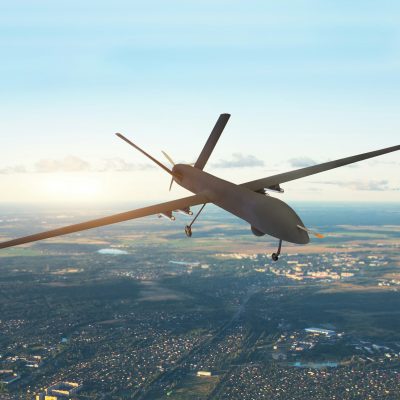
Ongoing conflicts, and foremost the war in Ukraine, are fundamentally altering perceptions of warfare and the technologies required for defence. Faced with the reality of operations, armed forces are being forced to adjust their priorities and redefine their requirements. Initially cautious at the start of the conflict, these analyses – based on lessons learnt from the Ukrainian experience – are gaining influence and are now directly impacting military planning, calling into question long-term projects often conceived as the generational renewal of existing equipment 3. This reorientation, illustrated by the widespread use of unmanned vehicles, is also structural, insofar as it affects the very process of designing these new weapon systems: these are developed in a more incremental manner, adapting in real time to user expectations and offering the capacity for continuous evolution. From this perspective, the Ukrainian battlefield has become a benchmark, as reported by local companies directly involved in the conflict4.
This new approach is fuelled by the more systematic exploitation of new digital technologies and the capabilities offered by artificial intelligence in the design, but above all the deployment, of equipment5. Often originating in the civilian sector, these software tools are the subject of significant investment, including through venture capital, and frequently play a decisive role in defining systems of which they constitute, in a sense, the brain. This has led to the emergence of new players, specialising in data processing and the use of AI for military purposes, who are playing an increasingly prominent role in the industrial landscape and are increasingly imposing their specifications on platform manufacturers.
This has led to the concept of ‘low-tech’ effectors combined with ‘high-tech’ AI, by the way including the aim of reducing costs… This reversal of roles between the software and hardware levels may fundamentally alter the structure of the industrial base and disrupt the traditional hierarchy between prime contractors and supply chains.
Favourable to restructuring, this trend is also characterised by the emergence of operators whose intangible, more fluid and less localised activities, and whose appetite for risk – often backed by private capital – are better suited to transnational partnerships.
A context now favourable to consolidation:
Three factors are currently driving industrial mergers in the European defence sector:
The first, of a political nature, relates to the United States’ stance of disengagement from NATO and the realisation by Europeans of the need to break free from their dependence on American industry. This will not happen overnight, but the issue of European preference in defence procurement – long considered taboo – has gained relevance in most European states. This new reluctance towards American competition implies a strengthening of supply in Europe and the emergence of competitive players of critical size.
The second factor relates to the funding programmes established by the EU for the defence industry (EDIP6 and SAFE7 being the most recent and significant): by their very nature, they have a unifying effect that influences both demand and supply, as they encourage joint procurement of European built equipment. The same applies to the European Defence Fund (EDF), which is financing R&D projects carried out in partnership between operators from different EU countries. These instruments, which facilitate collaboration between companies, also promote cooperation on programmes to meet a more aggregated demand. And they are set to be extended and strengthened from 2028 onwards under the EU’s next multiannual budget, with a definite impact on the alliance strategies of the companies that will benefit from them.
Finally, the third factor relates to the real but insufficient increase in the resources invested by EU member states in defence. The sudden escalation of threats no longer allows the piecemeal allocation of resources that has for too long characterised European military arsenals. The responsibility claimed by Member States regarding their defence can no longer, particularly in the eyes of their opinions, be reflected in the continued pursuit of a purely national approach to their arms procurement, the limitations and shortcomings of which are now glaringly apparent. Encouraging and accepting transnational industrial partnerships is a means of creating the conditions for better use of available resources by pooling them and reducing duplication.
The emergence of European champions in defence does not lead to a loss of competition. When it comes to major programmes, competitive tendering, whilst rare, often leads to serious disappointment (Germany, for example, had a costly experience with the F126 frigate programme). On the other hand, regarding supply chains, European market openness is a means of preserving a level of competition that is becoming increasingly difficult to maintain at the national level. This implies entering into a logic of mutual dependencies, but it is also a factor of resilience that allows for the preservation of multiple sources of supply.
Essential at least for financial reasons, the implementation of major cooperative armaments programmes generally faces the difficulty that national champions have to accept a joint governance, which reduces their managerial freedom and forces them to share their know-how. This is actually the main obstacle facing the FCAS project8, and one it would likely not face had it been entrusted to a single prime contractor (European or, at the very least, Franco-German…). The creation of multinational players can therefore also be seen, from the states’ perspective, as a way of delegating to industry the responsibility for successfully carrying out collaborative projects.
The argument that, to ensure the viability of a joint venture, it must be entrusted from the outset with the implementation of a cooperative programme – whilst it undoubtedly played a decisive role in the success of the MBDA missile manufacturer – is akin to the chicken-and-egg debate. Major cooperative programmes undoubtedly play a structuring role for the industrial base, but their success actually depends on the operators’ ability to reach agreement and cooperate (a condition that is obviously easier to fulfil when dealing with a single operator…). In this respect, the A400M programme led by Airbus has suffered more from differences between the participating states than from difficulties in the company’s management.
Finally, the major issue of recruiting the technicians and engineers that companies in the defence sector definitly need to ensure their development also argues in favour of consolidation. It is well known that the labour market for these professional categories is in short supply in a Europe struggling with deindustrialisation in many domains. Investment in new technologies and Europeanisation are powerful arguments for attracting them to the defence industry, whilst duplication exacerbates the shortage of these sought-after talents.
All in all, the conditions are in place to move forward with the integration of the EDTIB, which is proving more necessary than ever to ensure Europe’s defence by relying on an innovative and competitive industry. But it is up to the member states to impose their will on companies, of which they are the end customers, without succumbing to protectionist reflexes that no longer correspond to the reality of their needs or their means. This requires a determined opening up of procurement policies to European suppliers and mutual trust between national buyers. And it is also a test of political courage, at a time when rising budgets might lead one to believe, wrongly, that national withdrawal is once again a possibility…
Footnotes
1. 2024 data
2. Notably highlighted in the Draghi report.
3. An issue affecting, for example, the ongoing revision of the military programming law in France.
6. “European Defence Industry Programme”
7. “Security Action for Europe”
8. Future Combat Air System.
The necessary emergence of European defence manufacturers:
There are currently few multinational defence companies, but the model does exist. Among the major European players, there are three (whose performance is generally recognised): MBDA, Airbus and KNDS. Based on this model, when we speak of consolidation in the European defence sector, we naturally have in mind the creation of pan-European companies through the merger of national players who are often competitors (in reality, as they often benefit from national preference, these players are not truly in competition, except in the export market…). This highlights four arguments that are partly misguided: