Report
The European Debate in Sweden
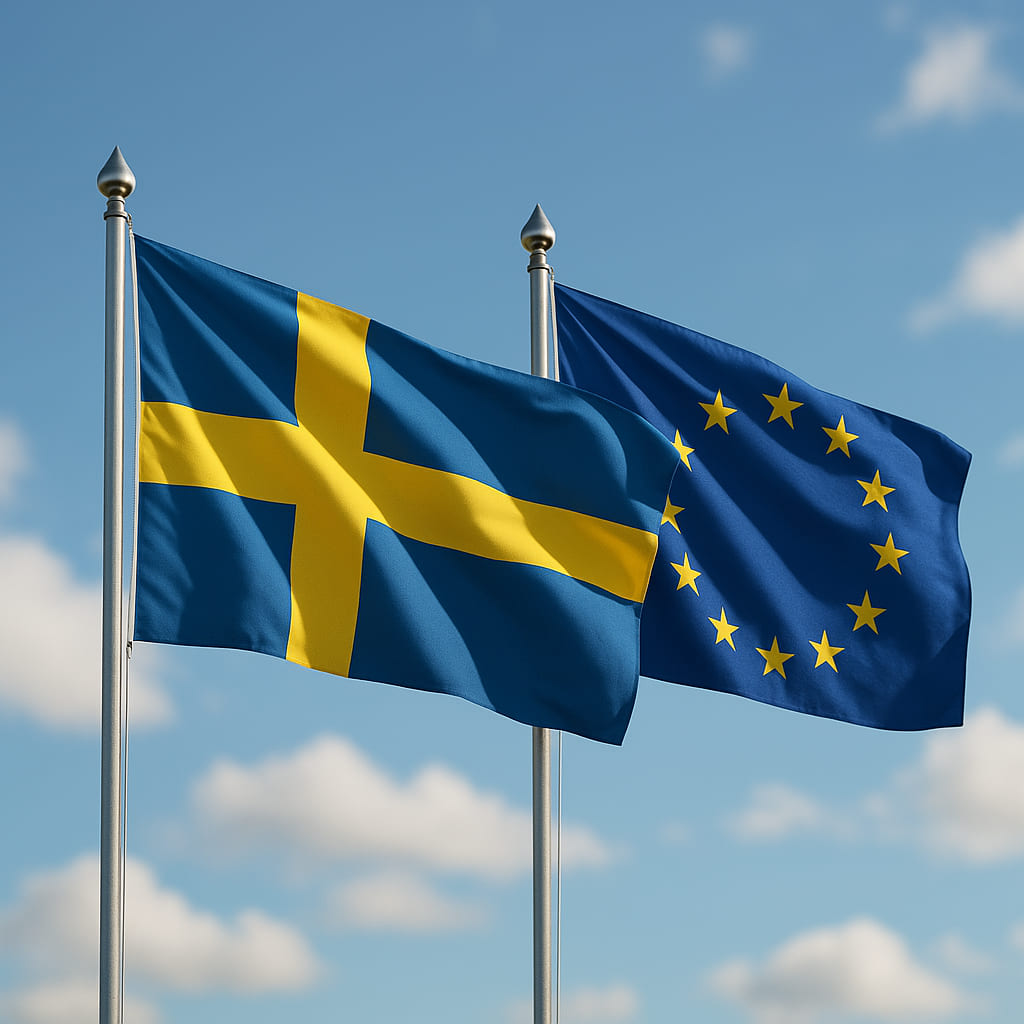
The expectations raised by Sweden’s first presidency of the EU must therefore be a very particular mixture of hope – what will Sweden be able to offer us from its model of democracy and social relations? – and of curiosity – how do the Swedes envisage the role they are to play within the Union? Also available in Swedish.
FOREWORD BY JACQUES DELORS
As far as opinion in Europe is concerned, Sweden comes across as an enigma in that her much-admired model of participatory social democracy would seem to be enticing her towards a systematically peripheral position within the European Union. The expectations raised by Sweden’s first presidency of the EU must therefore be a very particular mixture of hope – what will Sweden be able to offer us from its model of democracy and social relations? – and of curiosity – how do the Swedes envisage the role they are to play within the Union?
These are the questions Olof Petersson attempts so skilfully to answer within the limitations of the current Swedish debate. He begins by examining the paradoxes at its heart: a campaigning fervour for the single market and its enlargement combined with reluctance to accept a unifying system of regulation, a reluctance which runs entirely counter to the national model; placing the emphasis on democratic transparency while opting for the most opaque method of European governance: preferring intergovernmentalism to the method of community, and with marked doubts about the latter although it is the method better suited to the interests of a “small country”; a tradition of debating democratic issues in-depth…unless those issues are European.These contradictions are, after all, as good as any other and each country in this Europe of ours cherishes contradictions of its own. Olof Petersson tries to locate their roots in the particular way Swedish democracy works with its character of a continuous movement back and forth between the general public and elected politicians. It has, nevertheless, failed to find a way of adapting to the questions posed by the integration of Sweden within the Union, and subsequently by EMU. The price has been traumatic and long-lasting. Without making any claims to summarise this fascinating analysis, there are three reflections I would like to draw forth:
-
Swedish scepticism in relation to the consolidation of political union is eminently respectable: the country’s concern to preserve her unrivalled history of participatory democracy and social cohesion deserves to be appreciated.
-
-
The debate on membership of the EU, and of EMU, constitutes one of the rare failures of democracy “à la suédoise” in that it has exposed a gulf between the people and the political elites: this provides a subject for reflection on the deficit of affectio societatis currently on display throughout Europe.
-
This failure has revealed the existence of a deeper crisis within the Swedish model which, faced with the challenge of globalisation, is seeking to find a renewed form of constitutional government. As is often the case, political Europe appears to be both the agency of revelation and the possible solution to a problem of which it is not the cause. It is up to us to grasp this chance.
-
What reading this report, which Notre Europe is proud to publish, seems to make clear is that the Swedish presidency of the Union provides an opportunity, both for Europe – which can draw the benefit of a level of satisfying democratic and social requirements unmatched anywhere else – and for Sweden, which may discover in the exercise of this responsibility, the prospect of putting behind it in a positive fashion the questions left dangling by “the permanent referendum”.
SUR LE MÊME THÈME
ON THE SAME THEME
PUBLICATIONS
[FR] THE MOLDAVIANS AND THE EU: A STILL TIMID EUROFAVOUR
[FR] In the minds of the Balkans
[FR] Europe retains public favor in the face of the war in Ukraine
The Swedish energy transition.
A race far from won
[FR] European opinions on the war in Ukraine
United in diversity? National responses to the European energy crisis
FRENCH-STYLE EUROSCEPTICISM
EUROPEAN PUBLIC OPINION IN A TROUBLED 2020
FRUGAL MEMBER STATES VS. THE EU:
NOT TOO MUCH PLEASE
French public opinion and Europe
between distrust and ambivalence
Public opinion in Greece & the EU
Brexit has not won over european opinions, quite the contrary
The political climate in spain ahead of the elections
Appartenance assumée, adhésion réservée : évolution des opinions publiques sur l’Union européenne – de la crise à nos jours
Expectations and feelings, the state of public opinion before the European elections
The Spanish public opinions and the EU
They Love Me, They Love Me Not, They Love Me a Little: Public Opinion and the European Union in the Visegrad Countries
Allegro ma non troppo: European public opinions at the end of 2017
Italy’s Euroscepticism: A case of Victimhood and a Tale of Missed Opportunity
The Italians and Europe, Chronicle of Disenchantment
Europe, Germany, France: Evolution of Public Opinions
European public opinion and the EU following the peak of the migration crisis
Social Networks and Populism in the EU : Comparative Study
National Referendums on EU Issues: from Clarification to Frustration
Living Together Facing Fears: the French Political Dilemma
Brexit: between British Europhobia and continental Euroscepticisms
The EU and referenda: three denials of democracy
The EU, despite everything? European public opinion in the face of crisis (2005–2015)
TTIP and German opinion’s legitimate fears
The EU and referenda: structural incompatibility?
2014 European elections: an upsurge in Europhobia or business as usual?
Tsipras is not Midas: a break in continuity?
Euroscepticism or Europhobia: voice vs. exit?
The EU and referenda on independence: a leap in the dark?
European elections: What form of cohabitation between France and the EU?
What the French told us about the employement in the EU
What the French told us about the European democracy
What the French told us about euro
What the French told us about globalisation
Power to the citizens: Conditions for a European public space?
European Elections : less abstention, more populism?
Making the EU more democratic
Beyond the Troika: which divides and faces for the EU?
Leading Europe from the front
EU no, euro yes? European public opinions facing the crisis (2007-2012)
Consolidating the EMU, a vital task
Britain and Europe – The last rites?
“Germany strongly evolved during the crisis”
Brussels, 2 May 2012 – What Are the Risks of Small Steps in a Rapidly Changing World?
Do the Europeans still believe in the EU?
Public Opinion and the Eurozone Crisis – PEW Global Attitudes Survey
The European Union in touch with its citizens: the analytical tools of public opinion
The Citizens of Europe and the European Union in the Current Crisis
The European Union and the challenges of populism
Where is Germany Heading?
Listening to Europe’s citizens. An assessment of the first experiments in participation organised at EU level
Propositions by French civil society to national and European decision-makers
From institutional Reform to Mass Politics or How to Engage Citizens in the Union of Lisbon
European political parties: the missing link
We shall bring you our vices
Does the Union’s Action Meet the Citizen’s Preferences ?
Think Global – Act European I (TGAE I). The contribution of 13 European Think Tanks to the French, Czech and Swedish EU Trio Presidency.
The French Presidency of the EU Council
European Estates General: 3000 participants relaunch the debate
Towards a European public space? The European elections on June 2004
A Citizens Compact: Reaching out to the Citizens of Europe
Reaction of Pepper D. Culpepper and Archon Fung to Andrew Moravcsik’s article on the collapse of the Constitutional treaty
Reaction of James Fishkin to Andrew Moravcsik’s article on the collapse of the Constitutional treaty
Local development, partnership and bottom-up approach
The European Constitution and deliberation: the Example of deliberative focus groups ahead of the French Referendum of 29 May 2005
Securing a “Yes”: from Nice I to Nice II
European attitudes towards transatlantic relations 2000-2003: an analytical survey
MÉDIAS
MEDIAS
Otan : la Hongrie joue avec les nerfs des Occidentaux
Accession à l’Otan : la Suède et la Finlande trouvent la Turquie et la Hongrie sur leur chemin