The European treaties offer untapped opportunities to overcome deadlocks in foreign and security policy
Authors

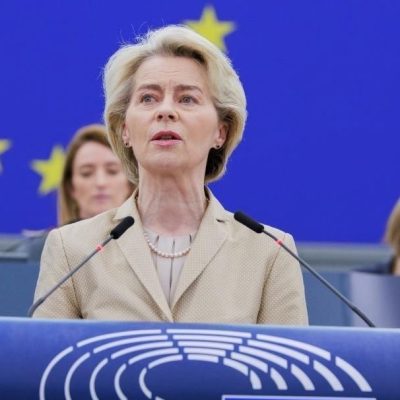
“Europe’s voice must be heard. All too often in recent times, Europe has failed to speak out”, acknowledged Ursula von der Leyen, President of the European Commission, on 19 April at the 80th anniversary celebrations of the German weekly Die Zeit in Hamburg. To break this deadlock, the Commission President intends to challenge the unanimity rule within the EU on foreign and security policy. The ideal solution would, of course, be to amend the treaties accordingly, but the current treaty provides the EU institutions with opportunities to overcome the deadlocks caused by the unanimity rule, opportunities which are not being sufficiently used.
A deadlock that threatens the future of the Union
Between the prolonged and repeated deadlock over sanctions against Russia and support for Ukraine caused by Viktor Orbán, the EU’s inability to exert pressure on Benjamin Netanyahu’s Israeli government to prevent it from violating international law on a daily basis, and the difficulties in finding a response commensurate with Donald Trump’s aggression and threats, it is of course impossible to disagree with Ursula von der Leyen. The unanimity rule in foreign and security policy prevents the European Union from defending its values and interests on an increasingly violent and volatile geopolitical stage. It is surely no exaggeration to consider that such deadlock threatens the very survival of the Union.
However, many European leaders have long highlighted this situation and called for this rule to be reconsidered, but does such a change not first require a modification to the European Treaties? This would, of course, be the most direct way to overcome this kind of deadlock. But, traumatised by the failure of the European Constitutional Treaty in 2005, no leading European leader dares to advocate taking this path for the time being. Furthermore, scrapping the unanimity rule in the Treaty would require the agreement of all Member States, which seems, at first glance, very difficult, if not impossible, for the time being.
The current Treaty offers scope for manoeuvre that is under-utilised
The current Treaties do, however, offer scope for manoeuvre that has not all been fully used to date. Title 5 of the Treaty on European Union sets out the rules that apply specifically to the Union’s foreign and security policy. Article 24 first provides a very broad definition of the Union’s role in this area: “The Union’s competence in matters of foreign and security policy covers all areas of foreign policy as well as all matters relating to the Union’s security, including the progressive framing of a common defence policy that may lead to a common defence”.
Article 31 does indeed confirm that “Decisions under this Chapter shall be taken by the European Council and by the Council acting unanimously, except where this Chapter provides otherwise”. But it immediately goes on to define a procedure that limits the scope of this rule.
“Any member of the Council which abstains from voting may, in accordance with this paragraph, accompany its abstention with a formal statement. In that case, it shall not be obliged to apply the decision, but shall accept that the decision commits the Union. In a spirit of mutual solidarity, the Member State concerned shall refrain from any action likely to conflict with or impede the Union’s action based on that decision, and the other Member States shall respect its position”. In other words, to commit the Union in matters of foreign and security policy, a decision does not actually need to be approved unanimously. It is sufficient for Member States that disagree to agree to abstain when voting on the matter.
An interesting super-qualified majority
The same paragraph of Article 31 then defines a sort of super-qualified majority which could and should guide future decisions in the field of foreign and security policy: “If the members of the Council who abstain and make such a declaration represent at least one third of the Member States comprising at least one third of the Union’s population, the decision shall not be adopted”. In other words, a decision on foreign and security policy can bind the Union provided it is approved by two-thirds of the Member States (i.e. 18 states at present, compared with 15 for the standard qualified majority) representing two-thirds of the population (65% under the standard qualified majority procedure). We could, and indeed should, make significantly greater use of the scope for manoeuvre offered by these provisions.
The second subparagraph of the same Article 31 goes even further. “By way of derogation from paragraph 1 [of Article 31], the Council shall act by a qualified majority:
When adopting a decision defining a Union action or position on the basis of a European Council decision on the Union’s strategic interests and objectives, as referred to in Article 22(1)
When adopting a decision defining a Union action or position on a proposal from the High Representative of the Union for Foreign Affairs and Security Policy submitted following a specific request made to him by the European Council on its own initiative or on the initiative of the High Representative
When it adopts any decision implementing a decision defining a Union action or position
When it appoints a Special Representative in accordance with Article 33
In other words, this article of the Treaty offers broad scope for the Council of Foreign Ministers to take decisions by the Union’s standard qualified majority, particularly in matters such as sanctions. Such a possibility could not, however, be used on defence issues. It was to this article of the Treaty that Ursula von der Leyen was referring in particular during the anniversary of “Die Zeit”.
Possibilities known but which the Member States refused to use
These provisions have long been known and discussed within European bodies, but until now most Member States had opposed any attempt to actually make use of them so that they might become the norm in this area. They fear losing their own veto power in the future and are also concerned that the European Council will become gridlocked if debate on the details of each measure is referred there, should qualified majority voting become the norm in the Foreign Affairs Council. In a context where the threats facing the Union have become considerable and where the double-dealing of a few Member States could be enough to destroy the Union, it is high time, however, to use all the room for manoeuvre offered by the current Treaty to avoid these deadlocks and equip the Union with a genuine capacity to act in the field of foreign and security policy, failing that we cannot change it quickly.