The industrial dimension of an expanded nuclear deterrence
Authors

It is now rare for a debate on the future of European defence to overlook the nuclear issue and its place in the security architecture that Europeans are striving to build. The concept of ‘advanced nuclear deterrence’, introduced by the President of the French Republic in his speech on 2 March 2026, has stimulated further reflection on this subject.
Nuclear deterrence, as is well known, rests on a combination of three elements which, taken together, contribute to its credibility: a doctrine of employment, a sole decision-making authority, and weapons that are among the most technologically advanced. As part of this third pillar, there is therefore an industrial dimension that is integral to deterrence. It plays a significant role in the defence economy and is potentially affected by the upheavals currently shaking the sector as a result of geopolitical shifts. To assess the extent of this impact, it is necessary to evaluate the resources that, directly or indirectly, contribute to the nuclear capacity, identify those resources that are partly beyond purely national control, and attempt to anticipate disruptions that could further increase these dependencies. The French proposal to broaden deterrence suggests that this potential shift should take place within a European framework.
1) A wide range of capabilities contribute to nuclear deterrence:
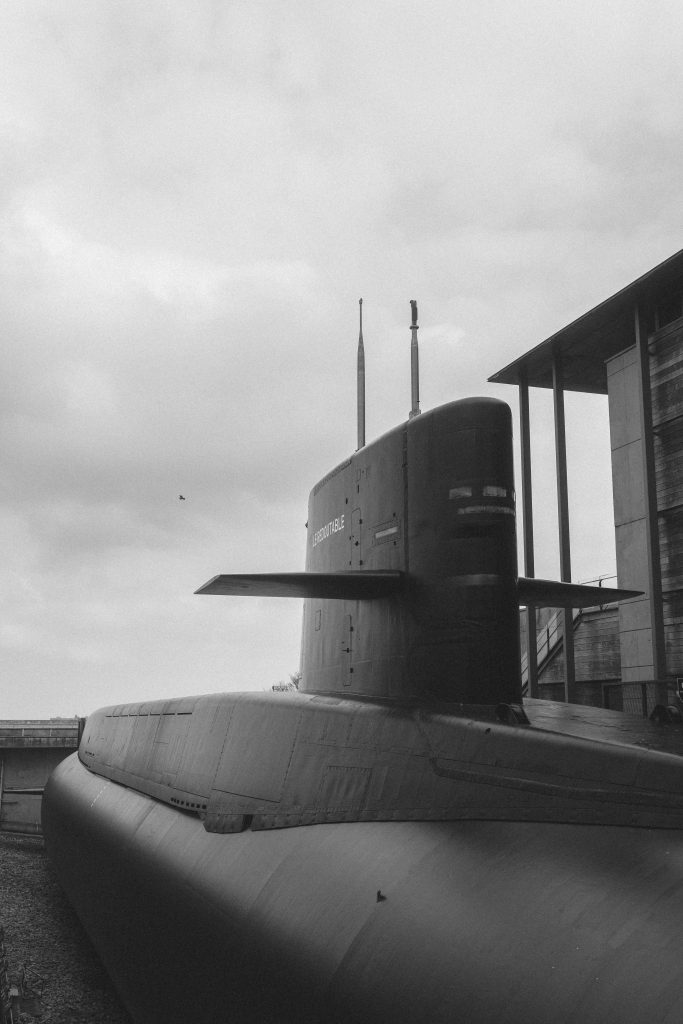
In addition to proper atomic weapons (the nuclear warheads), France has two systems capable of delivering these weapons: one is ballistic missiles carried by submarines (SSBNs[1]), and the other is air-launched missiles (from airfighters, some of which are based on aircraft carriers). For its part, the United Kingdom possesses only the submarine-based component.
The conditions under which these two types of delivery systems operate are quite different, and their combination contributes to the credibility of the deterrence force. Their deployment relies on critical assets such as: communications satellites and maritime patrol aircraft for SSBNs; refuelling airtankers and aircraft carriers for airborne missiles; and high-performance optical and electronic intelligence capabilities in both cases.
Some of this equipment, such as refuelling aircraft or communications satellites, has dual-use applications, both nuclear and conventional. The companies that produce them have this dual capability to meet the requirements of deterrence and the more flexible demands of conventional applications, or even of the civilian domain. It is known, for example, that ArianeGroup is the prime contractor for both nuclear ballistic missiles and Ariane launchers, capitalising on the technological synergies between these two types of rocket.
Taken together, these systems account for a significant share of the defence expenditure of the countries owning them. The portion allocated to strike systems (nuclear warheads and missiles) thus represents around a quarter of France’s military equipment budget in 2026. If we add the delivery and support platforms (critical for the deployment of missiles), this figure approaches one-third of that budget. It therefore represents a very significant proportion of the business of French defence companies, involving the main prime contractors and numerous subcontractors.
France’s investment in deterrence is seen by some as a justification for lower levels of spending in the conventional domain, where its European partners are today focusing their efforts. It is also responsible for the obstacles to cooperation on major programmes such as the FCAS, the abandonment of which – at least as far as the manned aircraft is concerned – is partly attributable to French requirements relating to deterrence (the French aircraft manufacturer using this as an additional argument to demand full prime contractor status for the programme…).
In any case, this brief description of the physical content of deterrence demonstrates its intrication with a defence industrial base that it underpins technologically, and its dependencies which partly fall within the conventional sphere.
2) National control over the means of deterrence is neither comprehensive nor static:
Firstly, it is obvious that some elements of the deterrence arsenal are the subject of multinational cooperation, creating a breach in the dogma of strict national independence in this field. This is the case, for example, with the refuelling tanker needed for the airborne component, which are derived from Airbus A330s assembled in Spain. Furthermore, there are items of equipment which, out of necessity, are sourced from abroad (such as the US-made catapults for aircraft carriers), not to mention some electronic components or raw materials essential for the production of weapons. However, these dependencies do not, in fact, affect the autonomy of use of these weapons, which is a fundamental condition of their doctrine of employment.
But the role played by technical components of deterrence that fall outside the scope of strict national sovereignty could grow. This is suggested by the concepts of ‘advanced deterrence’ and ‘strategic support (shouldering)’ highlighted in President Macron’s speech and which are now the subject of discussions with some European partners. These concepts involve cooperating on capabilities that play a vital role in the deterrence posture, such as early warning, extended air defence and deep strike capabilities.
The possibility has also been raised of stationing French nuclear weapons and their delivery systems (in practice, aircraft) in other European states, thereby helping to sanctuarize their territories. This would de facto imply a partnership in the operational support of these platforms and might open the door to a ‘dual-key’ principle[2] (which could however undermine the necessary single-person decision-making capacity regarding their use…).
These proposals are not merely doctrinal: if implemented, they would have consequences for the French deterrence industrial chain, compelling it to engage more deeply in European cooperation on both technical and programme-related matters.
This reality and these prospects show that, whilst a literal ‘Europeanisation’ of deterrence remains incompatible with a credible doctrine of use, sharing some of its physical elements with France’s European partners appears unavoidable and, in some respects, desirable for both operational and budgetary reasons. This approach, by paving the way for an initial pooling of resources devoted to this fundamental element of European defence, would also help to safeguard it from dependence on third countries (particularly the United States).
3) Like all armament systems, the technical pillar of deterrence may be facing major disruptions:
Without entering into the doctrinal debate, it must be acknowledged that the theoretical conditions for the use of nuclear weapons in the European theatre are being affected by the upheavals currently taking place in conventional warfare. Ongoing conflicts and the emergence of hybrid threats (acts of aggression not involving armed force) are significantly altering perceptions of a situation that could lead to the use of nuclear weapons. Although uncertainty is part of the deterrence posture, the concept of escalation – which underpins the notions of a crossing point and of a final warning, neither of which precluding a first-use[3] – is becoming less easy to grasp.
Highlighted by the situation in Ukraine, the massive influx of new technologies onto the battlefield – with the widespread use of robots, drones and AI software – is bluring the traditional approach to conflict, characterised by a step-by-step escalation. By undermining the relevance of conventional platforms – such as aircraft or missiles – produced following lengthy and costly development, this trend could also call into question the nuclear variants of these platforms, which are often sizing their requirement and performance.
The discussions currently taking place within general staffs to respond to these new operational paradigms [4] – together with the growing rivalry between established companies in the sector and new entrants from the tech industry – could therefore call into question the industrial balance upon which the physical content of France’s deterrent force has been built.
The introduction of AI and, in the longer term, that of quantum computing are further factors that could destabilise the nuclear equation, leading to a reassessment of the human factor within the decision-making loop and of the cryptology crucial to its operation.
In the immediate term, the budgetary cost of deterrence weighs heavily on this debate: as a weapon designed not to be used, it cannot, now more than ever, exempt its owner from a substantial rearmament effort adapted to the new context. The logical extension of this observation implies that the European defence undertaking, whilst needing to be more coordinated and pooled to yield results, should not exclude its nuclear component currently borne by France and the United Kingdom.
Whilst these reflections suggest that nuclear deterrence is not static, either in its principles or in its means, they highlight above all the overarching challenge posed by its desirable contribution to Europe’s defence posture in the context of a US withdrawal. Its future usefulness will depend on the role it is given within the defence strategy that Europeans are bound to develop together. This reality will not come about solely through doctrinal developments, but through a series of technological and industrial breakthroughs that will make the status quo untenable: increased convergence between conventional and nuclear delivery systems, digital integration of decision-making systems, reallocation of resources to capitalise on these duality synergies, multinational cooperation on critical equipment, pooling of intelligence, and so on.
Footnotes
- At Île Longue, a French Navy base housing nuclear submarines.↩︎
- Ship Submersible Ballistic Nuclear. ↩︎
- The regime currently in force for US nuclear weapons stationed in Germany, Italy, Belgium and the Netherlands. ↩︎
- See ‘The French Guarantee’, Benoît d’Aboville (Commentaire magazine, Spring 2026) ↩︎
- See ‘Speed is the Matrix of New Power’, Pierre Vandier (Le Grand Continent, April 2026) ↩︎