War in Iran: 100 days in, €60 billion out
Authors


One hundred days after the outbreak of the war in Iran, the European Union (EU) is paying an additional energy bill of approximately €62 billion. Member States have already adopted more than 210 emergency measures across 23 countries (excluding Finland, Malta, Denmark and Luxembourg), mobilising nearly €16 billion in public spending – on top of an estimated €46 billion increase in fossil fuel import costs. The situation is not merely an economic and fiscal burden but rather the direct consequence of Europe’s continued exposure to fossil fuels price volatility.
The tracker is accessible here.
Against this backdrop and as we previously documented in earlier versions of our tracker, electrification remains strikingly absent from Europe’s national crisis responses. Only 7 Member States – Croatia, Estonia, France, the Netherlands, Portugal, Spain, Sweden – have adopted measures explicitly supporting electrification. Confirmed spending amounts to around €1 billion, rising to approximately €2.5 billion when accounting for the estimated electrification component of Spain’s €5 billion anti-crisis package. Even under this more generous estimate, electrification represents just 15% of national crisis spending and less than 5% of the total bill. The remaining 85% is devoted to short-term relief that addresses the consequences of fossil fuel dependence rather than its causes. In other words, out of the €62 billion spent, only ~€2bn are being effectively channeled towards electrification.
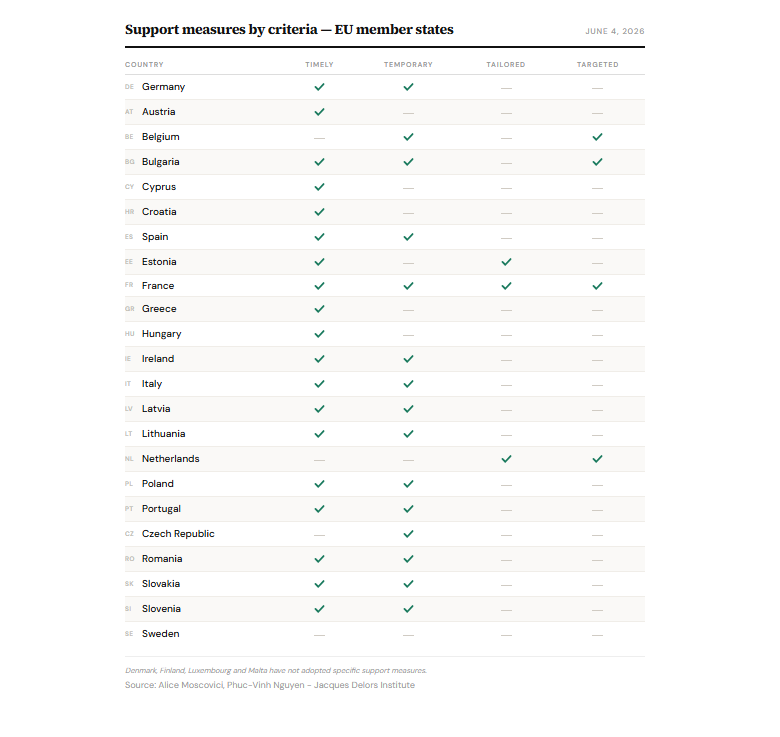
This imbalance is not for lack of guidance. On 22 April, the European Commission published its AccelerateEU communication, establishing a framework of three criterias for well-designed crisis measures: “timely”, “temporary” and “targeted”. A fourth – “tailored’, in the sense of preserving the price signal – can be added drawing on European Central Bank recommendations. Yet most Member States have largely disregarded these criteria: 21 out of 23 meet at most two out of four. Most measures are rightly timely and temporary, but they fail the targeted and tailored tests. Generic fuel tax cuts and blanket price caps dominate national responses, benefiting all consumers regardless of financial vulnerability, while doing little for the households and sectors most exposed.
Member States are not, however, without leverage. As they bear the economic and political costs of the conflict, they hold considerable leverage in shaping the European political agenda – and are beginning to exercise it. Their most tangible success to date has been securing an expansion of the existing National Escape Clause (NEC), originally designed for defence spending, to encompass targeted energy resilience measures. Crucially, the revised scope now includes support for households and firms aimed at reducing dependence on imported fossil fuels and accelerating electrification in end-use sectors, on a temporary basis. Crucially, its retroactive application to measures adopted since February 2026 creates fiscal space to recognise prior national efforts, effectively rewarding early movers (7 member states).
That said, the Middle East Temporary State Aid Framework (METSAF) instrument – shielding sectors most exposed to the oil and gas shock, including agriculture, fisheries, aquaculture, land transport and short-see shipping – and the NEC extension, however useful, remain conjunctural responses to a structural problem. The Commission’s electrification action plan – the instrument best placed to design a pathway to address the underlying issue – has been postponed several times, now to 22 July. With electricity generation in the EU already largely decarbonised (70%), electrification must be recognised not merely as a climate policy instrument but as a security and resilience imperative. The 18-19 June European Council must therefore serve as a critical juncture to provide the Commission with a clear political mandate to present its plan without further delay, alongside concrete, near-term measures capable of scaling deployment over the next twelve months.
The Member States best placed to advance this agenda are those that have built the strongest domestic case for it. The Netherlands has directed nearly 40% of its crisis-response spending towards structural measures – electric vehicles, home renovations, programmes for farmers, fishermen and SMEs to reduce their fossil fuel dependence – reflecting a deliberate choice to treat the crisis as an opportunity to accelerate the transition. The remaining 60 per cent is largely targeted at sectors and households most affected by the crisis. Spain has taken steps in the same direction, folding electric mobility, solar self-consumption and heat pumps into its response, though short-term relief still dominates the overall package.
France stands out for a different reason: it is the only Member State to meet all four criteria in our analysis, which gives it a particular legitimacy to push an ambitious agenda at the European Council. Its approach is also instructive in its own right. Faced with tighter budgetary constraints (budget deficit of 5,1 per cent of GDP), France has advanced electrification primarily through political mobilisation of private investment rather than large-scale public spending – using the acceleration of its national Electrification Plan and a recent presidential summit on electrification to generate a political signal strong enough to draw in private-sector commitments (close to 3 billion euros announced). France demonstrates that while fiscal constraints are real, they are not an excuse for inaction: momentum for structural change can be built even without deep pockets.
Europe is bearing the costs of a war it neither initiated nor joined, while continuing to spend billions to offset the fiscal burden of fossil-fuel dependence. This is not sustainable. Although Member States face broadly similar constraints, their policy responses will legitimately differ. Some may deploy public money to accelerate electrification; others may use political leadership to crowd in private capital. What cannot be justified is doing neither.