A Conversation with Kyriakos Pierrakakis : Competitiveness, Investment and Resilience: Europe’s Economic Future in a Fragmented World
Authors
 Kyriákos Pierrakákis Current Greek Minister of Economy and Finance and President of the Eurogroup
I’m delighted to be joining you here in Paris. It is a quite interesting time.
In a broader sense, as the quote says, “may you live in interesting times”. Unfortunately, for some weeks, we have felt that the times are too interesting. Having said this, in most meetings that we have participated in recently, in most Eurogroup meetings, there is always an acute focus on the crisis that we have in front of us.
In the last meetings, we discussed the implications of the closure of the Strait of Hormuz and the broader crisis in the Middle East, both directly in terms of energy prices and indirectly in the broader economic outlook. The stagflationary tendency is still there. We are not in a stagflationary perimeter, but we are in a stagflationary tendency. This is worrisome.
The European Commission and the requisite European authorities are changing the predictions of the economic outlook for this year: upwards with regard to inflation, downwards with regard to growth. We are monitoring the situation closely.
Other topics, of course, are equally or even more important if we look at them from a macro perspective. The implications of artificial intelligence, the new Mythos LLM of Anthropic, are also an area of concern with regard to its proper governance and the regulatory status that it will have.
Overall, the era of geopolitical innocence for Europe, I think, is over.
In this regard, we have an obvious dividend in front of us. The “dividend of the obvious” is a term that I like to use because it is very good. Greece had this when we were exiting our own crisis in the previous years. It is very good to have an obvious thing which you have not done for a long time and, if you do it, it will produce a growth dividend.
For Greece, this was a series of chronic reforms, accumulated reforms that had not been done in all policy areas and in all policy sectors, building on top of political stability and fiscal stability.
For Europe, this is the Savings and Investment Union, together with the deployment of the Digital Euro.
The Savings and Investment Union is an area that European Ministers of Finance discuss in meetings. It is not one thing. It is one title, but it is a decomposed series of agenda items, from banking consolidation to stock market integration to scaling up startups in Europe: a series of agenda items across Europe.
I think that, right now, there is momentum to see this completed.
The Letta Report and the Draghi Report have played a very significant role in outlining what those significant policies should be with regard to capacity-building the competitiveness of Europe.
Right now, for instance, we are discussing the Market integration and supervision package and how we can capacity-build the role of ESMA (European Securities and Markets Authority) at the European level. In a recent discussion that we had at ECOFIN, I had the chance to say that, for me, it is obvious that we should not be doing the same thing 27 times; that we should be capacity-building ESMA’s role in Europe overall because, as technological innovation accelerates and accelerates further, we need to capacity-build our regulators to be able to monitor the markets and play their proper role in the markets. It is much more obvious that we should be doing that centrally rather than 27 times over. So this is one of those areas.
Apart from capacity-building the role of Europe centrally, I would say that we also need orchestration between and amongst the Member States.
At the recent Eurogroup meeting in Nicosia, at an informal ECOFIN meeting, we had the chance to discuss housing. In many countries in Europe -I speak with my colleagues daily – we have a housing challenge. In other countries also, I can say there is a housing crisis.
This is not a central competence of the European Commission. It is more within the capabilities of Member States. But in areas such as housing, the least we can do as finance ministers is, first, discuss the topics that interest citizens and engage with those topics; and second, learn from one another. Learn from policies, from successes and failures, from mistakes and challenges, to be able to deploy policy at speed, at scale, and with optimal results.
All those things taken together, I would say, codify a perimeter within which European policy can advance. It can advance more quickly than in the past.
As, in a similar meeting, one of the participants told me : “It seems like we need to do all of those things at once – the things that have not happened for generations in Europe -. There seems to be a need for simultaneous deployment of solutions.”
And the answer is yes.
It befalls on the shoulders of this generation of policymakers, after the energy crisis, after Russia’s invasion of Ukraine, after a series of exogenous events to the European Union, to capacity-build effectively a sovereign Europe.
I am quite optimistic. This is not a ‘yes-or-no’ thing. It is not a ‘yes-or-no’ answer. It is not a ‘black-and-white’ issue. It is more a question of how much distance we can cover.
And I am optimistic that distance can be covered. Right now, there is momentum at the level of the leaders of the European Union to cover as much distance as possible.
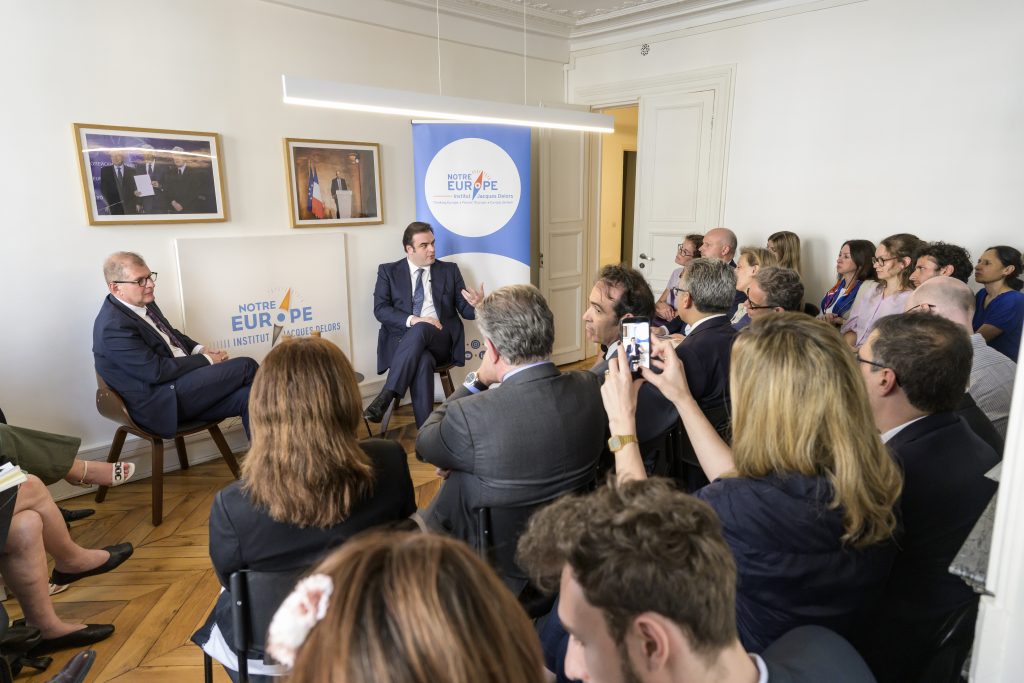
Well, thank you. This is very encouraging. I think it’s very wise also from our perspective here. We have been working on that to link the Savings and Investment Union with this idea of a strategic autonomy of Europe, of European strategic autonomy. Because indeed, through financing and by channeling savings into the real economy, into the real European economy, we can finance and fund investment in European public goods. From security, defense, but also infrastructure, digital, education, sustainability transition, and so on. And we have seen, as in the Letta report and the Draghi report, that much of these European savings are leaving Europe for other markets, particularly the United States.
Somehow that was kind of tolerable when there was a very strong alignment with the United States. Today it is not as it was, to say the least. So we are really — it’s really encouraging that you say that there is momentum and there is progress.
Do you see any area of the Savings and Investment Union where something concrete could be achieved in the next months? We have been working here particularly on this idea of channeling savings into the real economy. So the idea of the savings and investment accounts, on which the Commission has already provided a recommendation, but it’s only a recommendation. So we may — we should perhaps expect something more. But your view will be important.
I will say that the question here is to cover many things at once and simultaneously, because there are areas where there will be obvious progress. We’re discussing the supplementary pensions package and the market supervision package. So in those areas, the incoming Irish presidency is showcasing optimism and willingness to move both agendas — the overall Savings and Investment Union agenda, but those two packages very much forward. But I would say that we plan to integrate all elements of the discussion, of the Eurogroup discussions, of the Eurogroup agenda.
You mentioned channeling savings into investment in Europe rather than doing it in the United States. If you look at the startup ecosystems of Europe and various member states — and I’m still using the term ecosystems, whereas it should be a startup ecosystem in Europe — we still have a fragmented experience of how our startups are scaling up in Europe. And even then, any startup in Europe knows that after some point, if it wants to grow, it might require American investment funding. It should be an option. It should be an option for a startup to be a Delaware corporation. It shouldn’t be a necessity. We should be able to have this within Europe.
Can the 28th regime play a role in this regard? Yes, it can. But this is one area where I think progress can be made. Banking consolidation is also an area where more progress is necessary. And in a sense, I’m a strong proponent of William Faulkner’s advice to young writers: “Show, don’t tell.”
I’m the Minister of Finance of a country where UniCredit recently obtained a significant portion of one of Greece’s most important banks, Alpha Bank, and Euronext entered the Athens Stock Exchange. We need European champions. We don’t need national champions from some parts of Europe. That is the natural consequence, the natural implication of both the Letta and the Draghi reports. And we certainly need that in the areas where more innovation is necessary.
I recently had the chance to present to my peers at the Eurogroup a couple of slides on banks and banking consolidation, where I think two points stand out. The first is the level of technological investment by European banks in comparison to American and Chinese banks: it’s less. So we certainly need more technological investment on the part of banks so that they can compete globally. And the second is cross-border M&As in the banking sector in Europe after 2008, 2009, and 2010, after our sovereign debt crisis – and they have declined, whereas we need more of them.
So those are things to take together. Part of it is rulemaking. Part of it is regulation. Part of it is policymaking at the European level. Part of it is national political appetite. It’s about us having the same vocabulary to describe things, understand events, metabolize events, and produce policy. And this is why I started this answer by telling you that in the case of Greece, wearing my national hat rather than my Eurogroup hat, we have this understanding because we see that an additional growth dividend can be there.
Greece is currently growing at around 2%, which is more or less double the European average. But we understand that we need more growth, both at the Greek level and at the European level. We need more productivity. We have a productivity challenge in Europe. We cannot achieve that if we don’t engage with bigger players at the European level and don’t manage to catalyze more mergers. So this is going to be part of this agenda. And we certainly need the development and deployment of a common vocabulary.
I think, to end on an optimistic note, that this mindset is becoming more apparent and more vivid at the level of leaders. This was the outcome of the recent retreat, where they asked the finance ministers to be able to deliver results very quickly on the Savings and Investment Union – but also at the level of the finance ministers themselves. This will require concessions, which is a very European line of thinking, I would say. But I’m seeing countries moving towards a consensual approach of being able to deliver what is asked of us.
This is indeed good news, because we have seen over the last months, over the last couple of years, a lot of resistance to banking consolidation. In Italy, in my country, we had a lot of banking consolidation domestically, but we faced some resistance abroad – though not in Greece, as we have seen.
You mentioned technology, and I understand you are following very closely the work on digitalization, the digitalization of finance, the tokenization of finance, and the creation of the digital euro, which may see the light in the next couple of years. For the layman, what is the purpose of that? Because this is a question we receive most of the time. What is the function of the digital euro, and what would be the benefit for the general population and the economy at large?
Well, digitalizing payments – before we enter specifically into the digitization of currency – can play a huge role, generally, with regards to transparency and with regards to how your economy operates and the world that we live in.
Before we look at the currency, what I can tell you is that part of the reason why my country managed to achieve this was the motivation to capture tax evasion. We managed to capture tax evasion because, first, we created an independent government authority, and second, because we managed to digitize tax collection and payments. You don’t need to be extremely sophisticated for things to be practical and to produce results. You need applicable solutions, and a simple rollout of Point of Sale machines to small and medium-sized enterprises in the case of Greece worked miracles with regards to tax collection. Capturing tax evasion produced a social dividend. I think this was quite important, and it is recognized as such in my country.
Now, this is with regard to payments and the digitization of payments. The digitization of currency is a much, much broader experiment. And there are certain countries that are not pursuing the digitization of their currency. China is. China would like a digital version of its currency. In the United States, they have opted not to do this. The core strategy there is built around private innovation happening around the dollar, rather than a public digital alternative. So the focus is on stablecoins. And there, the GENIUS Act is instrumentalizing stablecoins as part of a broader strategy that the Americans have around their overall macroeconomic management.
In our case, the stablecoin race is one where we have a very limited presence in Europe. 95% of stablecoins are dollar-backed. Less than 1% are euro-backed. But where we do have the capacity to progress quickly is through the creation of public infrastructure, which will enable us to build the international role of Europe. And this is none other than the digital euro. This is now in the hands of the European Parliament. There will be a vote – in the designated Committee first, and then the full Parliament — later this year. We might, and I hope we will, have a positive outcome and a pilot project for the digital euro quite soon. The plan is then to deploy it by 2029. The quicker we deploy it – as the overall management of the economy is moving digitally – the quicker we will have a digital manifestation of our currency, and the better it will be, both for the sovereignty of our currency and for the overall management of the economy. The whole economy is moving digitally. So it is better to do this with a very strong and sound public infrastructure.
We need to have a strategy around this, of course. So in this dilemma between private innovation and strong public infrastructure, the answer should be: doing both.
So, you see complementarity between, for example, European-based stablecoin and digital?
Absolutely. And it might be there is no other way. Because if we look at what is happening globally, much of the US and China, the US is only opting for private innovation. China is only opting for public infrastructure. We should do both. Combining the best of both. And the best of both is to have the strong public infrastructure, which will play a huge role, transparency-wise, credibility-wise for our currency, and then allow for this private innovation to occur around the public infrastructure. The micro-regulation is playing its part in this regard, but we should continuously adapt. We should continuously move, because this is an area where innovation has accelerated in the last years. I am quite optimistic that this is an area where you will see tangible results, as I mentioned just before.
As our economies are exposed to global developments — as has been demonstrated, for instance, with market prices on energy or inflation — I wanted to know what measures you have discussed, for Greece or for the Eurogroup, that could potentially be put forward in response to the conflict in the Gulf in terms of energy resilience. And what do you think is the impact of this geopolitical situation on the Eurozone?
Well, first, we have started discussing energy policy at the level of the finance ministers. And this is not a mission creep. This is not only the natural implication of what is happening in the Middle East. We had already put energy on the agenda in the previous Eurogroup discussion, before the events in the Middle East manifested themselves. And we did that on purpose, because we understand the strategic importance of the competitiveness of the Eurozone with regards to how we optimally design our energy policy.
That is observation number one. Observation number two is that if you look at what the IMF presented quite recently, the impact of the crisis in the Middle East is 12% less than what it would have been had we not taken a series of measures following the Russian invasion of Ukraine. So taking short-run measures that align with long-run strategic priorities does help. And this is why we are experiencing the impact of this crisis at 12% less than what it would otherwise have been.
My third observation is that reacting to such crises has long-run implications. Take the 1970s. The response to the two oil shocks of the 1970s had significant long-run implications: the creation of the IEA, more North Sea oil exploration, more nuclear capacity building in places like France – 40% of its nuclear capacity was built after the 1970s. And, unfortunately, it also led to an increased appetite for Soviet, now Russian, energy sources.
If you add everything up, what is clear in Europe right now is that we need a single European energy market, and we don’t have one. What do we need to do in the short run? We need to support our citizens, especially the most vulnerable. The European Commission has defined the perimeter of acceptable measures: they should be well-designed, targeted, and certainly temporary — because certain measures tend to be sticky, and if they are sticky, what we do in fiscal policy ends up contradicting what is happening in markets. So you need to be able to support the most vulnerable in a targeted fashion, and what you do needs to fit your long-run priorities.
What is clear in Europe? We need more interconnectors. We need more storage. We need to invest in grids – hundreds of billions in grids.
Overall, this is necessary in order to achieve our medium-term strategic priorities, and this is why finance ministers need to have a very clear roadmap for getting there. All of this, of course, happening alongside the technological innovation taking place in the energy field, which is quite significant and quite important.
I have a two-part question on safe assets. What should be the next steps to convince countries that are still hesitant? And to convince investors of the effectiveness of European safe assets?
You know, the role of President of the Eurogroup does not allow you to express your own mind. It allows you to express what the consensus is. So, speaking in my Eurogroup capacity, I will tell you that the safe assets discussion is not one where we currently speak with one voice. And I think that is quite honest, because we have differences of opinion on certain things, while on others we have already crystallized a common position. On the Savings and Investment Union, we have increasingly crystallized a common position. On the digital euro, we have crystallized a common position. So the more we crystallize these positions, and the more we define the technical parameters of agreement, the better it is for Europe to move forward faster.
On safe assets, or on the energy measures we mentioned earlier – such as whether we will allow for escape clauses, as the Italian government has advocated – there is a divergence of opinion right now as to what should happen or how it should happen. This is certainly the case on safe assets. Some governments are more focused on this and on common issuance. Other governments are more skeptical. What I can tell you right now is that this will certainly be a topic we return to in the coming months.
I have two questions, if I may. The first is on the digital euro, which you already mentioned. You had unanimity in the Council — so congratulations. In the European Parliament, however, it looks more difficult. And you can see that it mirrors a discussion happening in each member state, where there is a strong divide, if I may say, between public institutions and private banks. That is at least the situation here in France. So, on top of the arguments you just developed, what would be your main argument to convince private banks that they will not lose out from the digital euro — that it can be a win-win situation?
My second question relates to the 28th regime, because you mentioned early discussions happening around it. And rightly so, you discussed the idea of European champions — we all know that the original idea behind the 28th regime, also present in the Letta report, was about scale-up. But could this structure be helpful in building European champions at a larger scale, for example in financial markets? And finally, do you think there is a chance that we can maintain sound regulation in this space?
That would be open for debate. But let me start from the last point. The 28th regime can play a beneficial role, overall, from a philosophical point of view.
Given that I was a minister before – I was education minister before finance, but I was also digital minister for four years – what I kept saying is that digital is not about technology. It’s about design. And about how we design rules. So if we look at what states are, they are structures, they are processes, and they are human resources. And if you look at the processes of states and governments, you might think they were never actually designed. They have simply occurred – as an accumulation of decentralized decision-making, both at the national level and globally. But you need a designer, and you need to make the way the state works human-centered, not state-centered.
To be able to change that, companies call this business process engineering. But government process engineering is not something that has really happened — not significantly. It is more difficult for governments that have a federal nature in their own policy design to apply those principles to certain parts of a given process. Renewing your driver’s license, enrolling your child in kindergarten — those simple things. If you redesign them properly, it is actually easier to do so at the level of a city or regional government than at the level of a state or federal government. If you look at the technologies that the American federal government is using – excluding national security – and how citizens interact at the state or local level, you don’t get a Silicon Valley feeling from that experience. And this is the same in Europe, maybe only not in the Baltic and North European States. So
What we tried to do in Greece was to integrate simple technologies to change the experience of citizens. So if you think about the 28th regime, it is like trying to create a simplification of how businesses or European citizens interact with governments — and rather than trying to fix the existing 27, you create an additional 28th that is simple enough for that interaction to become seamless. Can this facilitate the creation of champions? Yes. The simplification of rules is always positive. But I would say that the core difference here is one of a mentality shift — and a necessary one, at the European level.
And first you have the mentality shift, and then you move towards communications policy and common vocabulary. Take Strategic Autonomy. I prefer the word sovereignty to autonomy. Autonomy is one-dimensional. It is not the whole picture. Sometimes we decide to relinquish elements of our autonomy – that is what we did when we entered the European Union. You relinquish autonomy, but you end up gaining more. Because we live in an interdependent world. And the question for you is not to be asymmetrically interdependent. You need to be strong enough so that interdependence works in your favor too.
In this regard, we do have champions in Europe – many champions in many fields. ASML, Ericsson, Airbus, many companies that hold European champion status. Can we grow them further to compete globally? Are there champions who could scale up even further? And if we look at technology, how would you redesign the rulemaking in Europe to achieve this?
Consider telecom policy in the following sense. Ericsson and Nokia were the two companies that benefited from the policies of the first Trump administration, when governments were looking for equipment that was neither American nor Chinese for their 5G infrastructure. And ironically, that policy ended up helping European companies – there was no real American champion offering 5G infrastructure equipment at that point. It was two European companies, one Finnish and one Swedish.
So what could we have done differently? Well, first of all, not having 27 separate spectrum auctions would have been a good start. Because when you speak to a company like Deutsche Telekom, they deal with one regulator in the United States, and up to 27 regulators in Europe. You need one rulebook, one regulator, one auction, and one philosophy.
What we did in Greece, for instance, was to run a swift auction in order to roll out 5G quickly, and then we took 25% of the auction proceeds and created a fund — the idea being that the fund would enable the creation of an ecosystem for 5G applications.
I am being very specific here, but I think it makes the point. Imagine the counterfactual: one auction across Europe, one fund leveraged by the EIB, which finances 5G applications where Europe already has champions — and suddenly you are building significant capacity around those champions. That is industrial policy at its best. You create European champions at a global level by redesigning the way European policy works in a specific field. This is entirely consistent with the concepts that flow naturally from the Letta and Draghi reports.
We have not done this. But we certainly can – and should – in order to further grow our champions. The 28th regime will play a role there. But in reality, I think we need the mentality that we must move at speed and scale up very quickly. That would be my core argument.
The ostrich policy does not shape the future. You either shape it, or you are shaped by it. And if we don’t participate in redesigning the rules, we will end up as price takers rather than market makers. We should not be afraid of change. We should embrace it – because otherwise we will end up protecting something that is already fading away.
We need to change many things, and I think it is quite wise that the European Commission has included financial literacy within the remit of Maria Luís Albuquerque. Because we need to change the way we invest and the way we understand financial vocabulary — and the variation in financial literacy across European member states is quite significant in itself. This will change the way we operate in terms of our personal and family savings, and how we channel them. There is a different appetite for risk in the United States, and a different appetite for risk overall in Europe.
But if you look at the other side of the coin, what we have not done for a long time has come at an obvious cost. The more we manage to deliver on the overall Savings and Investment Union agenda, the greater the growth dividend we will see – collectively and individually as Member states.
You mentioned European sovereignty and European champions. But when we talk about industrial policy, we have to make choices. How do we balance the need for evenly distributed growth across the European Union?
You focus on your winners and you grow your winners. If I were to frame this, I would say we have three options: you build, you lead, and you regulate.
You build your capacity and build your champions – which is exactly what the reports call for – by creating ecosystems around those players and by allowing more cross-border M&A at the European level.
Second, this can take a different form in certain areas. There are areas where we, as Europeans, decided that for reasons of national security and strategic autonomy, we would create champions where we did not previously have them — Airbus or Galileo, for instance. There are areas where you have a very good chance of reaching the technological frontier quite quickly, if you make the investment in a fast and nimble manner.
And then for everything else, you make a choice – because you do not have infinite funding capabilities – and that choice is to be a really smart, really surgical regulator. Smart regulation requires you to be very aware and very literate when it comes to all the technological aspects involved. If you are trying to regulate the cloud, for instance, you need to understand the cloud quite well. When you are interacting with an American hyperscaler, you need to know the language, the vocabulary, and the technical specifications of every system. So are we doing that? We are, but we can do it better.
To be direct: we need to be able to do all three in a coherent manner. We need to be able to make those choices. And those choices need to happen at the European level to be viable. But I think it is a fully realistic scenario that they will happen — as long as we have a full mapping of all the areas where we can be the leading champions and leading actors at the global scale, and as long as we have the mentality of creating ecosystems around our winners.
Flexibility in fiscal policy, introduced during Covid and sustained throughout the various crises that followed, helped many countries, including Greece. But there are some deficits that are still there and growing. How are we going to deal with fiscal imbalances?
It is a balancing act, particularly in light of what is happening right now as a consequence of the crisis in the Middle East.
Every finance minister and every government in Europe is being called upon to support its citizens – especially the most vulnerable – because of inflationary pressures. This is real, it is present, and it affects all of us.
The way you do this — and the devil is in the detail — needs to be maximally effective. If fiscal policy contradicts monetary policy, it is not maximally effective; it is actually counterproductive. What do the IMF and the European Commission recommend? Policies that target the most vulnerable.
With regard to the escape clause you mentioned — whether in the context of Covid or otherwise — the escape clause allows you to spend more and deviate from the new fiscal framework we have introduced in Europe.
The idea behind the fiscal framework is that you conduct counter-cyclical policy in the following sense: you agree upon a specific level of spending for each year, and then regardless of whether you are in deficit or surplus within a certain perimeter, you operate as you planned. This allows you to spend more in difficult times and to repay your debt in times of growth — in a manner that reflects not just cyclical conditions but also the structural policies you have implemented. In Greece’s case, capturing tax evasion allowed us to deploy the additional surplus we generated.
This is difficult to explain to a broader audience, but it has its own logic. If you have a framework, deviating from it should be something you do on an extraordinary basis, not a routine one. Russia’s invasion of Ukraine made it mandatory for all European member states to increase defense spending. I come from a country that had maintained elevated defense spending even before, given its geopolitical situation and the challenges it faces. Other countries were not at that level, and this is why we allowed the escape clause to materialize for defense.
There is now a debate at the European level about what flexibilities should exist, with different countries taking different positions. What we certainly agree on at the European level right now is what types of policies we should be implementing, regardless of the degree of fiscal flexibility — because if we look at the overall fiscal position of European countries today, it is worse compared to 2022. That must be taken into account when making these assessments. Greece’s fiscal position happens to be strong and solid, and we are among the fastest-declining debt trajectories in the world right now. But the overall situation in Europe is not one where deficits have been addressed.
All of this taken together requires us to be quite targeted and quite surgical in our response, and to aim for the optimal policy mix. We are continuously engaging with the European Commission about the perimeter of acceptable measures, and given the external context, we are adapting the way we apply those rules accordingly.
Your country’s economic and fiscal trajectory is one that is quite remarkable so the question is simple : how did you do it? how did it happen? and and which reforms from the European Union were instrumental to your success ? and perhaps more importantly, which lessons could be the most useful for other countries that are currently struggling ?
You mentioned European sovereignty and European champions. But when we talk about industrial policy, we have to make choices. How do we balance the need for evenly distributed growth across the European Union?
You focus on your winners and you grow your winners. If I were to frame this, I would say we have three options: you build, you lead, and you regulate.
You build your capacity and build your champions — which is exactly what the reports call for — by creating ecosystems around those players and by allowing more cross-border M&A at the European level.
Second, this can take a different form in certain areas. There are areas where we, as Europeans, decided that for reasons of national security and strategic autonomy, we would create champions where we did not previously have them — Airbus or Galileo, for instance. There are areas where you have a very good chance of reaching the technological frontier quite quickly, if you make the investment in a fast and nimble manner.
And then for everything else, you make a choice — because you do not have infinite funding capabilities — and that choice is to be a really smart, really surgical regulator. Smart regulation requires you to be very aware and very literate when it comes to all the technological aspects involved. If you are trying to regulate the cloud, for instance, you need to understand the cloud quite well. When you are interacting with an American hyperscaler, you need to know the language, the vocabulary, and the technical specifications of every system. So are we doing that? We are, but we can do it better.
To be direct: we need to be able to do all three in a coherent manner. We need to be able to make those choices. And those choices need to happen at the European level to be viable. But I think it is a fully realistic scenario that they will happen — as long as we have a full mapping of all the areas where we can be the leading champions and leading actors at the global scale, and as long as we have the mentality of creating ecosystems around our winners.
How much of the Industrial Accelerator Act is actually going to be correctly implemented, given that Europeans do not seem to be converging on how they envision Europe’s industrial capacity in the world?
A core part of thinking in terms of sovereignty is trying to build European sovereign capacity. There are certain low-hanging fruits. The most obvious is defense — we can have more joint procurement in defense. Here in Paris you have the European Space Agency, and it has demonstrated that you can do common procurement, common design, and common space policy on many fronts. We can certainly replicate that in many areas beyond defense.
More broadly, there are many areas where we can build European production capacity, and I think there is convergence on that — we all understand this. The question is the one raised earlier: what specific choices will be made within that decision-making process to determine who the European champions will be, and how to build their capacity in the most effective way.
Authors
- Kyriákos Pierrakákis Current Greek Minister of Economy and Finance and President of the Eurogroup