The Circular Economy: A Strategic Lever for Europe’s Industrial Sovereignty
Authors

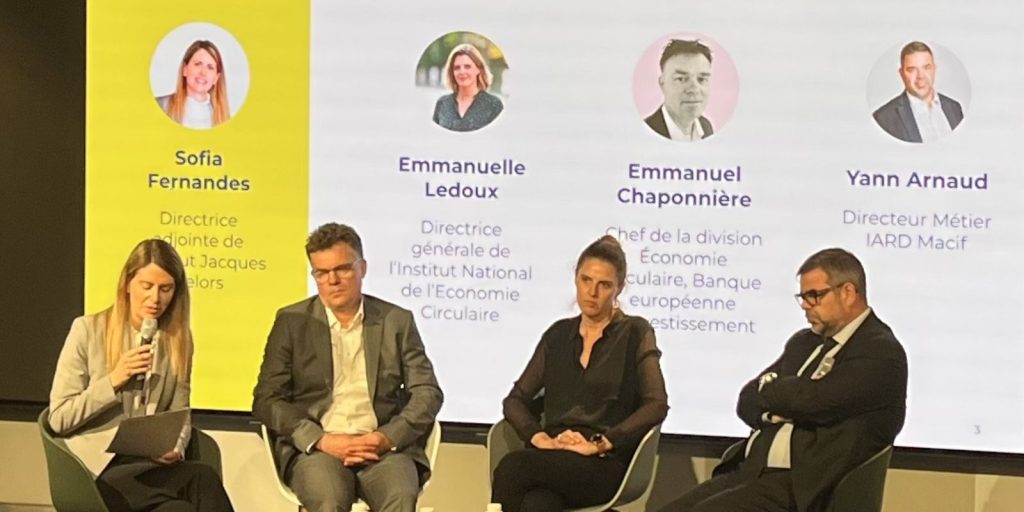
On 20 May, la Macif and the Jacques Delors Institute organised a conference bringing together three distinguished speakers to discuss the challenges of furthering Circular Economy as a lever for industrial sovereignty, decarbonisation and regional revitalisation: Emmanuelle Ledoux, Director General of the National Institute for the Circular Economy (INEC), Emmanuel Chaponnière, Head of the Circular Economy Division at the European Investment Bank (EIB), and Yann Arnaud, Director of Property and Casualty Insurance at Macif.
The debate, introduced by Jean-Louis Grosse-Delasalle, Chairman of la Macif, and moderated by Sofia Fernandes, Deputy Director of the Jacques Delors Institute, highlighted various challenges linked to the development of a Circular Economy, summarised below.
1. A Circular Economy: from the green transition to challenges surrounding our sovereignty and competitiveness
Long confined to the environmental sphere, a Circular Economy model is now perceived as a structuring tool for advancing our economic security, industrial resilience and competitiveness. Europe has become aware of its heavy reliance on imported resources – raw materials, critical materials, energy – in a global context marked by geopolitical tensions and the volatility of supply chains. Every geopolitical upheaval – Chinese restrictions on critical minerals, tensions surrounding Greenland or Ukrainian resources – has so far served as a concrete illustration of this challenge.
In this context, a Circular Economy emerges as a tool for securing resources. By promoting reuse, repair, recycling and the reincorporation of secondary materials into industrial processes, it helps reduce dependencies on imports whilst limiting exposure to fluctuating global markets. Certain sectors are particularly exposed to tensions over raw materials or to challenges linked with decarbonisation, including the automotive and construction sectors, alongside battery production, textiles, and electronic equipment for instance.
Our speakers emphasised how competitiveness can no longer be viewed solely through the lens of production costs. The ability to keep resources, extend product lifespans and secure access to materials is becoming a strategic element to factor in economic performance. The reports written by Enrico Letta and Mario Draghi, on the Single Market and the competitiveness of Europe’s economy respectively, both emphasised the imperative of circularity for an economy that wishes not only to be more sustainable but also more competitive.
The speakers noted that whilst the narrative is now firmly established, challenges now lie in its practical implementation.
2. European action: progress and limitations
Since the 1970s, the European Union has gradually built a legislative framework towards advancing a Circular Economy. In 2015, an initial action plan was published containing around fifty measures, all of which have been implemented. In 2020, as part of the Green Deal, a second plan introduced regulations on eco-design, the right to repair, and targets for recycling and reuse. European action is not, however, limited to regulation; it is structured around four pillars: legislation, funding, coordination between stakeholders, and monitoring indicators.
In France, these priorities were reflected in the 2015 Energy Transition Act, the 2019 roadmap on the Circular Economy and the 2020 AGEC Act (Anti-Waste Act for a Circular Economy), which notably set the target of zero single-use plastic packaging by 2040, mandated reusable tableware in fast-food outlets and introduced an economic incentive – as a bonus – for repair.
Despite these advances, the circularity rate of the European economy was only projected to reach 12% in 2024, far from the target of 24% to be reached in 2030. The forthcoming Circular Economy Act, expected in the coming months, should create a genuine Single Market for waste and secondary raw materials, impose obligations to incorporate recycled materials within products, and steer public procurement towards circular products.
3. Economic challenges: financing, models and scaling up
3.1 A structural investment shortfall
A Circular Economy requires, first and foremost, a significant amount of infrastructure: collection, sorting, recycling and remanufacturing. If Western Europe is relatively well equipped, 50 to 60% of waste in Eastern Europe still ends up in landfills without being sorted. A joint study by the European Commission and the EIB estimates current annual investment in the Circular Economy at around €120 billion, 93% of which comes from the private sector and only 7% from the public sector. However, to comply with all existing directives by 2040, the investment shortfall is estimated at €82 billion per year, half of which is concentrated in a few sectors: construction (€18 billion), vehicles and batteries (€10–12 billion), and electronic and textile waste.
The EIB, who positions itself as “the Climate Bank”, has contributed €6 billion over the last five to six years to the Circular Economy – representing around 1% of its annual volume. The EIB deploys a full range of tools to finance the Circular Economy: direct and intermediated loans, supplemented by structured project finance for infrastructure. It also uses risk-sharing instruments (guarantees, venture debt) to support innovative or early-stage Circular Economy projects. In parallel, via the European Investment Fund (EIF), it invests in equity (Venture Capital / Private Equity) to support circular start-ups and scale-ups. Finally, blending mechanisms (grants + loans) and advisory services help to improve bankability and to structure projects.
3.2 The fundamental problem: uncompetitive secondary materials
The main economic obstacle to a Circular Economy is simple: secondary raw materials are generally more expensive than primary raw materials, as a linear economy does not consider their negative externalities. Two examples illustrate this in concrete terms. On example is plastic recycling: incorporation quotas first stimulated the European industry. Still, when Chinese producers began exporting recycled and cheaper plastic to Europe, it undermined European players who had invested in plastic recycling. Another example is textile recycling: fibre-to-fibre technology exists but produces a fibre six times more expensive than the raw material, leaving this technology with no buyers.
Furthermore, the economics behind the chemical plastic recycling sector (the EIB finances operations in this sector) are revealing: if oil prices are low, raw plastic becomes cheaper and recycled plastic loses competitiveness; if oil prices are high, the Circular Economy becomes more attractive and projects become more profitable. This illustrates the need for regulation requiring a minimum recycled plastic content in products, to create a stable market and sound business plans.
3.3 Public procurement: an underused lever
Accounting for 10 to 15% of GDP, public procurement remains the most direct lever to boost a circular transition. Still, existing obligations in this area lack enforcement mechanisms, rendering them largely ineffective. It is therefore essential to incorporate criteria favouring local and European suppliers into public procurement. Strong resistance is already emerging at European level on these issues, and all economic actors will need to mobilise to ensure there is no backsliding.
4. Repair and reuse: insurers as drivers of circularity
4.1 The strategic role of insurers
Insurers occupy a unique position in a Circular Economy: their business involves, in particular, repairing broken items, and they have a direct financial interest in prioritising repair over replacement. La Macif handles 2 million claims a year, of which each is presented with the choice between fitting a new part or a reused part. With this in mind, insurers are perhaps the only major economic players with a short-term interest in repairing and combating single-use items, thereby constituting a real counterweight to car manufacturers.
Additionally, la Macif’s mutualist model further reinforces this role: without any obligations to return profits to shareholders, it can accept near-zero profitability in the short term if this makes social sense. As such, it would act as a catalyst in the development of circular models that remain fragile.
4.2 The automotive sector: a textbook case
The average age of a French car is 12 years. Such an age makes a systematic replacement with new parts absurd. The 85% rise in the price of new parts over ten years, imposed by manufacturers, has paradoxically made reused parts much more competitive. The battle to win over policymakers has been won. The key link to mobilise is now the repairer, whose natural inclination is towards standardised new parts, which are logistically simpler.
Data and digital technologies play a decisive role in this transformation. If la Macif can inform an End-of-Life Vehicle Centre (ELVC) that it purchased 50,000 parts of a certain type the previous year, the recycler immediately recognises the existence of a market and can proceed to dismantling a vehicle rather than shredding it. Artificial intelligence applied to image analysis makes it possible to identify and less time-consuming. It characterises and matches available parts with repairers’ needs on an industrial scale – a task that used to be the domain of skilled craftsmen.
A warning has been raised regarding new manufacturing technologies: gigacasting – the moulding of entire body panels in a single piece -, developed notably by Tesla, reduces production costs but renders vehicles virtually irreparable at the slightest impact. Europe must assert its industrial model and incorporate repairability requirements from the design stage.
5. Territorial dimension: jobs, sectors and local revitalisation
5.1. Jobs that cannot be relocated
A Circular Economy holds great promises for local communities: bringing repair, collection, refurbishment and recycling activities back to local areas can create industrial jobs that are firmly rooted in the local economy and difficult to relocate.
These new professions often require high-level technical skills, particularly in fields related to batteries, electronics or complex equipment. They therefore represent a potential driver for reindustrialisation and the upskilling of the workforce.
Repairing an electric vehicle battery is not a job requiring no qualifications: it demands technical expertise, specific tools and dedicated training. It is in this sense that la Macif is investing in organisations such as Revolte (repair centres and training facilities in new skills with regards to electric mobility).
The circular transition will profoundly transform certain professions whilst creating new ones. Without an ambitious skills development policy, there is a risk of shortages of skilled labour emerging, which would slow down the pace of transformation.
5.2 Tensions in the value chain
The circular transition will create value in certain fields. Ultimately, it will also destroy it in others. A Circular Economy will not only produce winners. Each new model shifts economic value and undermines certain existing players. Discussions have shown that the success of this transition requires a systemic approach that considers entire value chains: producers, repairers, recyclers, social and solidarity economy actors, local authorities and consumers.
The case of batteries illustrates the risk of losing value to better-integrated competitors: in the absence of a local recovery network, the ‘black mass’ of used batteries is, so far, sent entirely to China for reprocessing, in recycling plants located in the immediate vicinity of production plants – a highly integrated circularity that Europe is still struggling to build.
Conclusion: The need for a collective narrative
Beyond regulatory and financial tools, the speakers emphasised the need for a more compelling political and societal narrative. Local reindustrialisation entails accepting new infrastructure, changes in consumption patterns and, at times, higher costs in the short term. The Circular Economy therefore raises fundamental questions about consumption levels, resource use and the desired development model for the coming decades.
The discussions revealed a strong consensus: the Circular Economy is now much more than just an environmental policy. It has become a matter of sovereignty, competitiveness, regional resilience and social cohesion. Its success will, however, depend on several factors: an ambitious European regulatory framework, massive investment, exemplary public procurement, the development of comprehensive industrial sectors, the upskilling of workers and a shift in consumer behaviour.
Beyond regulatory and financial tools, the speakers emphasised the need for a more compelling political and societal narrative. Local reindustrialisation entails accepting new infrastructure, changes in consumption patterns and, at times, higher costs in the short term. The Circular Economy therefore raises fundamental questions about consumption levels, resource use and the desired development model for the coming decades.
The discussions revealed a strong consensus: the Circular Economy is now much more than just an environmental policy. It has become a matter of sovereignty, competitiveness, regional resilience and social cohesion. Its success will, however, depend on several factors: an ambitious European regulatory framework, massive investment, exemplary public procurement, the development of comprehensive industrial sectors, the upskilling of workers and a shift in consumer behaviour.