Under the Applause, the Messages: What the State of the Union Address Tells Us
Authors

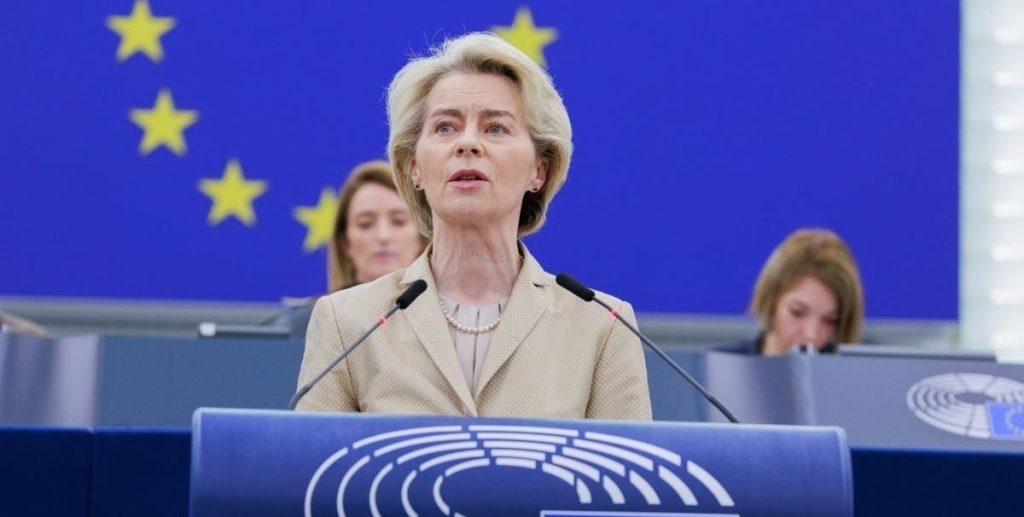
The State of the European Union address is a complex exercise in political communication, often caught between two contradictory imperatives: allowing the President of the Commission to set out her political and legislative priorities while also addressing the expectations of the various audiences hanging on her every word, from MEPs gathered in Strasbourg to representatives of the Member States, not to mention all the lobbyists and influencers immersed in the “Brussels bubble” and, indeed… her own administration! This major political and media event in European democratic life, inspired by the closer relationship Jacques Delors sought to build with the European Parliament during his second term in office, has now become an established feature of the institutional landscape, alongside the hearings of Commissioners-designate and the formal vote on the budget. Since 2010, it has also been enshrined in the interinstitutional agreement complementing the Treaty of Lisbon.
It is obviously tempting for commentators to subject this speech, delivered by the President of an institution that people love to hate, to a withering critique: never ambitious enough, too full of jargon, systematically disconnected from the everyday realities of citizens… And yet this annual address remains a fascinating political exercise, whose clearer signals, grey areas and underlying messages deserve close attention.
Ursula von der Leyen may not have succeeded in reassuring citizens that the EU has a sufficiently clear medium-term political horizon. However, she did address a large number of major issues, perhaps sketching out the contours of a new method and — if one accepts the premise of remaining pro-European — opening the way towards a new geopolitical vision for Europe. Nothing less.
On domestic issues, one of the key messages was her call to implement in full the recommendations put forward by Mario Draghi and Enrico Letta in their respective reports — published two years ago already! — and to finally complete the single market. This vast area of free movement of people, goods, capital and services, which Jacques Delors helped lay the foundations for, still has major gaps. The euro and Schengen give us the false impression of an almost fully integrated continent where movement is unhindered. In reality, national markets remain largely sealed off from one another economically, socially and in regulatory terms. Administrative hurdles too often hamper the free movement and marketing of goods, despite the extensive body of case law developed by the Court of Justice since Cassis de Dijon. The freedom of establishment is constrained by the diversity of companies’ legal statuses, commercial rules and national requirements resulting from the excessive transposition of directives.
In response, the Letta report in particular, Much More Than a Market, set out clear objectives and operational measures: a genuine Savings and Investment Union (SIU) to channel available capital towards the needs of growing European companies, and a “28th regime” — more appropriately termed Eu.Inc — designed to drastically reduce administrative and regulatory costs for businesses through a single registration system and a genuine simplification drive. Yet Ursula von der Leyen devoted little attention to these issues in her address to the European Parliament. For her, the Commission has done its job and put the necessary legislative proposals on the table, in line with the roadmap set by the Member States at the European Council in Nicosia. “Ladies and gentlemen, co-legislators, take responsibility,” she seemed to be saying… while making it quite clear that she was also looking towards the Council! It has to be said that, when it comes to the “28th regime”, a significant number of Member States, including Sweden, the Netherlands and Austria, oppose the legal basis chosen by the European Commission — although supported by France and Germany — and seek to demonstrate that the best way to simplify the single market is through 27 national transpositions of a directive rather than a single regulation! The Institut Jacques Delors’ working group on the SIU, which brings together several French companies that rank among the world’s largest, will soon publish its first conclusions and make recommendations to the negotiators.
On external issues and the “second China shock”, the President reiterated the European Union’s now established position towards its powerful competitor: the trade relationship is dramatically unbalanced, with a deficit of €1 billion a day, yet domestic demand in China has weakened and the Middle Kingdom needs the European market, particularly for its exports of high-value-added products. It was on the basis of this analysis that Ursula von der Leyen issued a forceful warning: “we will use all the tools at our disposal” in these negotiations. Yet, as we know, this reading of the situation is not shared by China, which believes it will soon be ready to reap the dividends of its massive investments in the “Belt and Road Initiative” and the commercial opportunities they create. The many contacts maintained on the ground by the Institute’s EU-China working group point to a clear divergence in assessments and a hardening of the relationship.
On AI, there was a major shift in emphasis. Last year, the priority was still to mobilise capital and public investment to compensate for the weakness of European “unicorns” as they entered their consolidation phase, while they are now being dramatically outpaced by their American competitors. Has Europe officially lost the race? Perhaps. In any case, the objective has changed: the focus is now on a limited number of technologies in which Europe can achieve excellence — in agriculture, transport, healthcare, defence and elsewhere — in other words, areas where Europe has an immense reservoir of competitiveness: the refined and readily available data of 450 million users, consumers and patients across 27 countries. These are the areas where the Commission President now says efforts must be concentrated. Through which budgetary instruments, and on what timetable, we unfortunately do not know, as the laborious negotiations over the 2028–2034 Multiannual Financial Framework were prudently left unmentioned… Just weeks before the Irish Presidency is due to table its quantified negotiating proposal, the so-called “frugal” countries, backed by Germany, continue to call for several hundred billion euros in savings. The Institute’s experts, who worked with our colleagues in Berlin on a detailed analysis of French and German positions in the days following the initial proposal for the 2028–2034 Multiannual Financial Framework on 16 July 2025, are being called upon extensively to provide expertise on this crucial issue for Europe.
The remainder of the speech was clearly intended, above all, to win over the European Parliament, an institution that has become dangerously unpredictable since the 2024 elections and the emergence of counter-majorities across a broad right-wing arc of the chamber, with the European People’s Party acting as the pivotal force. Let us recall that, between the introduction of the co-decision procedure under the Maastricht Treaty and the election of Ms von der Leyen in 2019, the Strasbourg assembly rejected only five texts in 26 years. It has already rejected four in the past six years. The regulation on deforestation served as a full-scale test, and almost every legislative text now requires painstaking negotiations.
By mentioning the need for new own resources to parliamentarians frustrated by their inability to raise taxes, announcing an imminent proposal to restrict access to social media and harmful digital content for young people to legislators eager to demonstrate a tangible impact on Europeans’ everyday lives, and reaffirming the importance of climate issues, decarbonisation and energy prices to elected representatives often perceived as being remote from local communities and citizens, she secured several rounds of sustained applause with little effort — something she had become unaccustomed to in this chamber. Indeed, the Presidents of the Socialists and Democrats group and then the Renew Europe group, in turn, followed her lead, solemnly calling on MEPs to pull themselves together and rebuild the historic centrist alliance that has underpinned their institution’s negotiating power and institutional credibility. Will the influential German delegation within the EPP reconsider its position following the electoral results in Saxony-Anhalt the previous week and in Mecklenburg-Western Pomerania this week? There lie the underlying messages. The Institut Jacques Delors’ working group on institutions, which analyses parliamentary coalition strategies vote by vote, will soon share its preliminary conclusions.
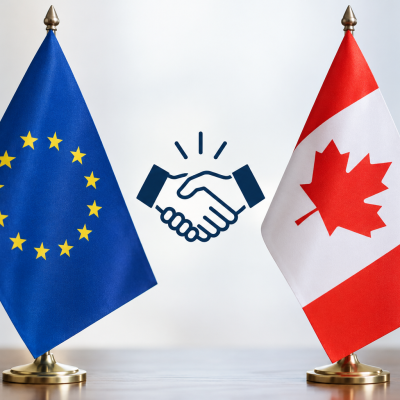
As for the grey area of her speech, by reaching out on behalf of Europe to Canadian Prime Minister Mark Carney, who was also present in the chamber and received sustained applause, Ms von der Leyen may have opened up one of the most exciting prospects of recent years. Even if the legal framework remains uncertain, even if the contours of this future alliance are still unclear, and even if the political backing of the major capitals is not yet fully secured, it is difficult not to be surprised that a project of such unprecedented scale and potentially far-reaching implications has not generated more enthusiasm in the hours and days following this declaration. Particularly in France, a nation historically built on the conviction that belonging rests more on a shared political will to defend the same values than on rigid geographical criteria or immutable legal foundations…
Of course, creativity will be required and, since this is a first — as it appears that the proposed status is not that of an “associated state” within the meaning of Article 217 of the Treaty — we will need to think outside the box. But that is precisely the role of think tanks and their main added value in public debate: to open up perspectives that public institutions may overlook, to explore alternative paths that administrations are not prepared to take, and to bring together perspectives from different fields of expertise that would otherwise not cross-fertilise outside our working groups. The Institute’s “Economic Security and International Trade” programme, which has developed particularly close relations with Canada, will undoubtedly be one of the most appropriate — and already one of the most advanced — places to carry out this major task effectively.
One final word on the new method to which Ursula von der Leyen referred somewhat cryptically. Having repeatedly called on the Member States to take responsibility, as we have seen, on the budget, simplification and the single market, but also on Gaza, she also called for a founding act on the scale of the 1948 Hague Congress, thereby invoking the legacy of Winston Churchill. The President of the European Commission has set a date for the first half of 2027, for a new European congress marking the 70th anniversary of the Treaty of Rome. Neither an intergovernmental conference, nor a Convention on the Future of Europe, nor an extraordinary summit of Heads of State or Government, nor a citizens’ deliberative conference… but a different format for a different outcome.
At a time when 2027 will inevitably be marked by political instability, with national elections taking place in all the major countries, the European Union remains the pillar of institutional and legal stability we need to sustain, over the long term, the difficult responses to the immense challenges imposed upon us by geopolitical, climate, energy, migration and democratic crises. The engagement of organised civil society, and of European think tanks in particular — at a time when their public funding, particularly from the EU, has been subject to drastic cuts that threaten their very existence at the worst possible moment — will be decisive. The Institut Jacques Delors, together with its counterparts in Berlin and Brussels within the Jacques Delors Foundation, will play its full part.