Europe & Associates
Authors

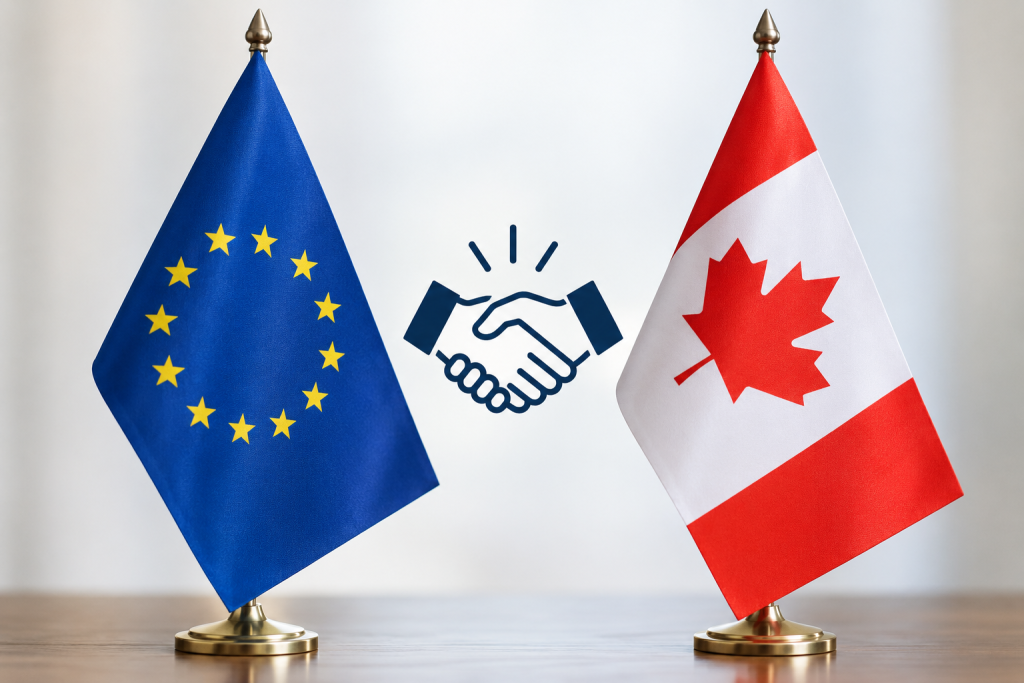
Whatever term is used to describe the closer cooperation between Ottawa and Brussels, this substantial rapprochement establishes a new form of resistance to the brutalisation of the balance of power.
In a world order thrown into disarray by the return of empires – an expression that sums up the pressures, threats and other means of coercion exerted, each in its own way, by Moscow, Beijing and Washington – the European Union and Canada feel less isolated by drawing closer together. Prime Minister Mark Carney’s visit to Strasbourg on 16 and 17 September, to standing ovations from MEPs, was a celebration of shared values and principles in a world that tramples them underfoot.
Commission President Ursula von der Leyen’s offer to grant Canada the status of ‘first associate member of the European Union’ reflects the need to translate the ‘elective affinities’ – in Mark Carney’s words – between Europe and Canada into a substantive rapprochement. This unprecedented proposal for a close partnership was welcomed by the Canadian Prime Minister, though he did not dwell on the specific designation itself.
For Canada, in the midst of a tariff war with Washington, the primary objective is to diversify its trade markets, whilst for the EU, it is to secure alternative supply chains for rare earths and energy. The EU–Canada summit scheduled for 29 and 30 October in Montreal will provide an opportunity to set out in detail the full range of potential industrial cooperation and deeper exchanges, going beyond what is already permitted under the Comprehensive Economic and Trade Agreement (CETA) currently in force and the Security and Defence Partnership signed last year. The areas discussed range from digital technology and low-carbon technologies to space, LNG and payments.
But this rapprochement is neither purely economic nor transactional. Its carefully orchestrated nature sends a clear geopolitical signal to other powers – first and foremost to Washington. “I’m not proposing a third bloc in order to become a great power rival, only with better manners,” Mark Carney argued. But it is indeed about demonstrating that the EU and Canada are drawing closer to learn to manage without the United States, rather than competing for its favour, and to begin building an alternative form of transatlantic relationship. With his immediately hostile and even threatening reaction, Donald Trump is making it clear that he has seen through the manoeuvre.
The EU–Canada relationship, although based on a high degree of mutual trust, is not immune to power dynamics either. Clearly, Ottawa and Brussels are not playing in the same league. Canada has a population of 40 million; the EU, 450 million. The concept of an ‘EU associate member’ serves precisely to signal to Canada that it is positioned within the orbit of the Twenty-Seven and not on an equal footing with them. But if this status – which has yet to be legally established – were extended to other countries with no intention of joining, or which are on the long road to EU membership, the group as a whole would become a powerful force for upholding the rule of law and the primacy of rules in an increasingly multipolar world. An alliance of ‘middle powers’, as Mark Carney described it earlier this year in Davos, with the EU – which already constitutes such an alliance in its own right – serving as the centrepiece. The United Kingdom, which also hopes to hold a summit with the EU – possibly in November in Brussels – will no doubt seek its place within it. By holding out the prospect of Canada becoming the ‘first associate member’, Ursula von der Leyen is suggesting that there could be a second, a third, …
What, then, of Australia, South Korea or Japan in the long term? It all depends on the elective affinities Europe finds with a given country. The European project is not about changing its scale, but rather about serving as the core of an alliance of countries that identify with the principles underpinning liberal democracy, the market economy and open trade, and which support one another in their defence, by boosting and securing trade among themselves, and by equipping themselves with potential joint instruments against external blackmail and interference. This is a vast endeavour to resist subjugation to hegemonic powers, in the face of which, as Mark Carney warned, ‘if you’re not at the table, you’re on the menu’.
He was received at the European table with full honours. Europeans will make up the largest contingent in this ‘alliance for the future’. They will wield dominant influence within it by virtue of their deeper integration. But for the time being, one must acknowledge that, intellectually speaking, Mark Carney has won the day. During his charm offensive in Strasbourg, MEPs gave him a long standing ovation, hailing the resistance to Trump that he embodies. It was as though, in the absence of any obvious internal leadership, the Twenty-Seven had, for the time being, found one from outside.