Why Marine Le Pen’s draft budget threatens the future of Europe (and therefore of France)
Authors

On 6 September, Marine Le Pen presented her alternative budget proposal for 2027 and the fiscal policy she intends to pursue during her five-year term should she be elected President of the Republic next May – a scenario that, at present, does not seem unlikely. One of the main cost-cutting measures she plans to implement involves drastically reducing France’s contributions to the European Union. By doing so, she would threaten the future of the continent, and therefore of France.
It is almost exclusively through a massive cut in public spending that Marine Le Pen intends to restore balance to the public finances. She has indeed stated her intention to bring public spending below 50 per cent of GDP by 2032, down from 57.5 per cent this year. From this perspective, Marine Le Pen is therefore fully in line with the movement championed in the United States by Donald Trump and in Argentina by Javier Milei. She thus plans numerous cuts to the state’s expenditure as well as to the social benefits received by migrant workers but also by all others french citizens.
Reducing France’s contribution to the EU by a factor of five
However, a significant portion of the savings she intends to make – 11,1 billion euros from 2027 and 15,3billion per year by 2032 – involves reducing France’s annual contribution to the European Union budget whilst, at the same time, demanding that the EU return €2.2 billion in customs duties collected at France’s borders. France’s contribution to the EU budget currently stands at around 25 billion euros per year. It would therefore reduce this contribution by 60 per cent over the course of her five-year term.
However, the European Union’s budget accounts for only 1.1 per cent of the 27 Member States’ combined GDP. And a significant proportion of this budget – one third – is currently used to fund the Common Agricultural Policy (CAP), of which France is, by far, the main beneficiary amongst the 27 Member States. It is this policy alone that keeps French agriculture afloat, even if there is room for debate as to how this windfall is distributed today.
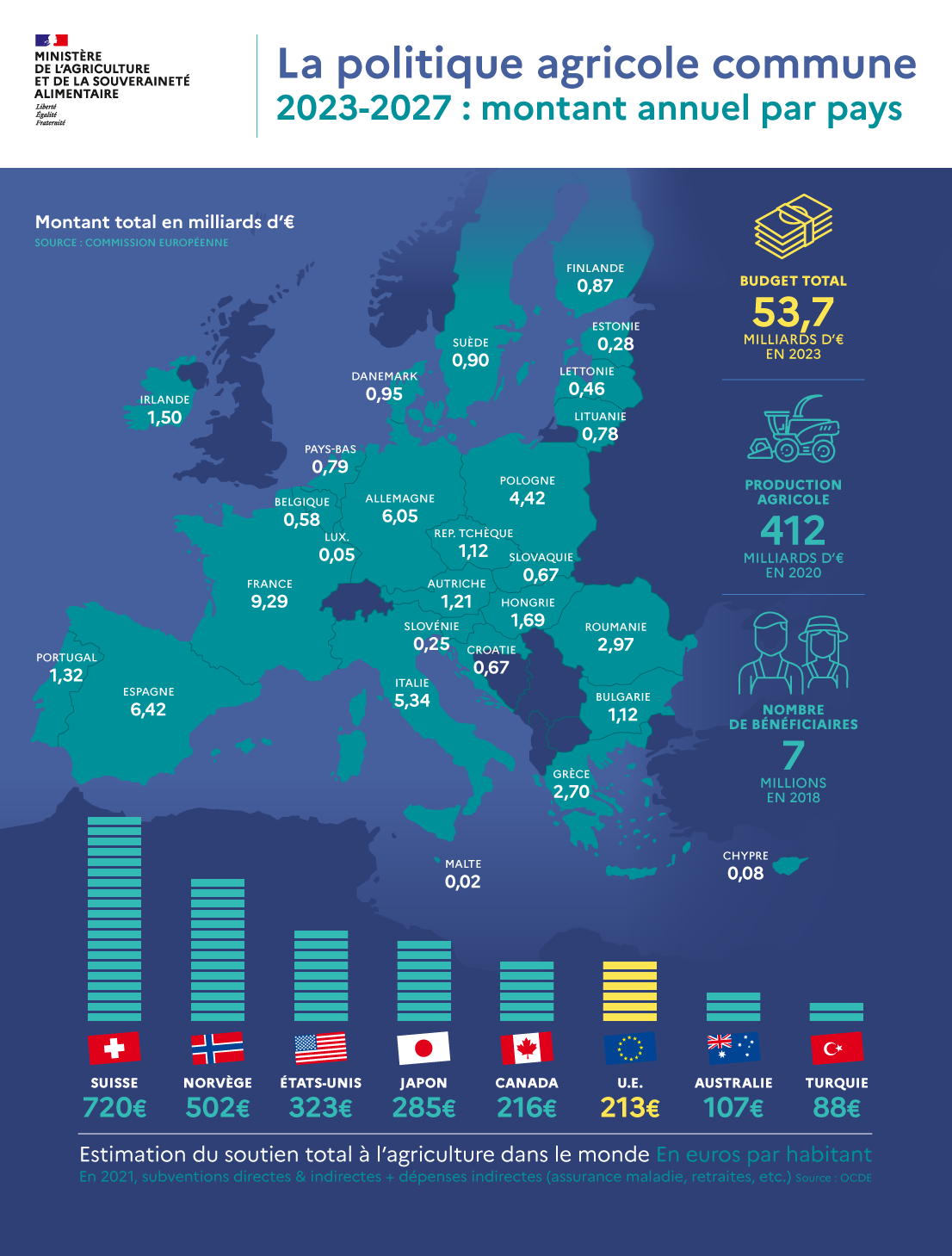
Given the dire situation currently facing many French farmers, one might well wonder about their future if the ‘cost-cutting measures’ proposed by Marine Le Pen were actually implemented. If the State were to step in to replace the CAP in supporting their incomes, this would, in any case, bring absolutely no benefit to French taxpayers.
Furthermore, there is broad consensus amongst all observers and economic stakeholders that France and Europe can only stand a chance of weathering the current geopolitical climate if we work more closely together at European level, even though there are, of course, differences of opinion regarding the priorities to be set and the ways in which this should be achieved.
In the face of climate change and its increasingly dramatic consequences, we do indeed need stronger European solidarity mechanisms in the event of natural disasters and enhanced civil protection at EU level, including, for example, a European fleet of Canadair aircraft.
To successfully manage the energy crisis we are currently facing, we would need larger European strategic reserves and to set up joint procurement of gas and oil. To accelerate the electrification of our economies, we must strengthen interconnections and integrate our electricity systems much more closely, whilst providing stronger support for this transition at EU level.
Given the dramatic deficit in our trade in industrial goods with China, particularly in sectors linked to the energy transition, we need a powerful industrial policy that is closely coordinated at European level and backed by substantial resources, if European industry is to stand any chance of withstanding the Chinese steamroller.
In the face of Russian aggression against Ukraine – and, increasingly, against all EU countries – we have all the more reason to rapidly strengthen our defence, particularly as the Americans are simultaneously withdrawing their support. But it would make no sense – and would be ineffective – for each country to act on its own at national level, particularly in the defence industries. This means we must pool significant financial resources.
Given the dire dependence we in Europe face on American tech giants – with potentially very serious consequences, particularly for freedoms and democracy – we need to invest heavily to catch up and restore our sovereignty, as suggested in particular by the reports by Mario Draghi and Enrico Letta in 2024. But this can only make sense – and stand any chance of success – if we do it together across the whole of the Union: challenges such as AI or microelectronics clearly cannot be tackled at national level.
In short, it is clearly not less money that the EU needs for its budget, but quite the opposite: much more. And it is, unfortunately, regrettable that, in the context of the ongoing negotiations on the Multiannual Financial Framework for 2028–2034, EU leaders are not prepared to meet this imperative by significantly increasing the EU budget, nor to take on joint debt again, as Mario Draghi had advocated and as was done in 2020 with Next Generation EU.
However, the cuts advocated by Marine Le Pen to France’s contribution to the EU budget would obviously make matters much worse still, and would block any prospect of ever managing to pool more resources to tackle the challenges Europeans will face in the coming years. She does not say this openly because the French have realised that, on their own, they could never manage, and that it would cost her votes, but this desire to deprive the EU of virtually all its means of action amounts, in practice, to seeking the end of the European project.
The RN wants to prevent Europe from standing up to Trump, Xi and Putin
Money is the sinews of war, as the saying rightly goes. By seeking to strip the European Union of sufficient resources, Marine Le Pen would indeed ensure that France and Europe lose the battle against climate change and for the phase-out of fossil fuels, the battle for Ukraine’s independence and against the Russian military threat, the battle against the onslaught of Chinese industry, and the battle against the dominance of American big tech companies over our lives.
In truth, the only ones who might rejoice at seeing such a policy actually implemented would be Donald Trump, Vladimir Putin and Xi Jinping. Marine Le Pen often claims to defend France’s sovereignty, but with her proposals regarding France’s contribution to the European Union budget, she is in reality promoting above all the interests of hostile foreign powers.